

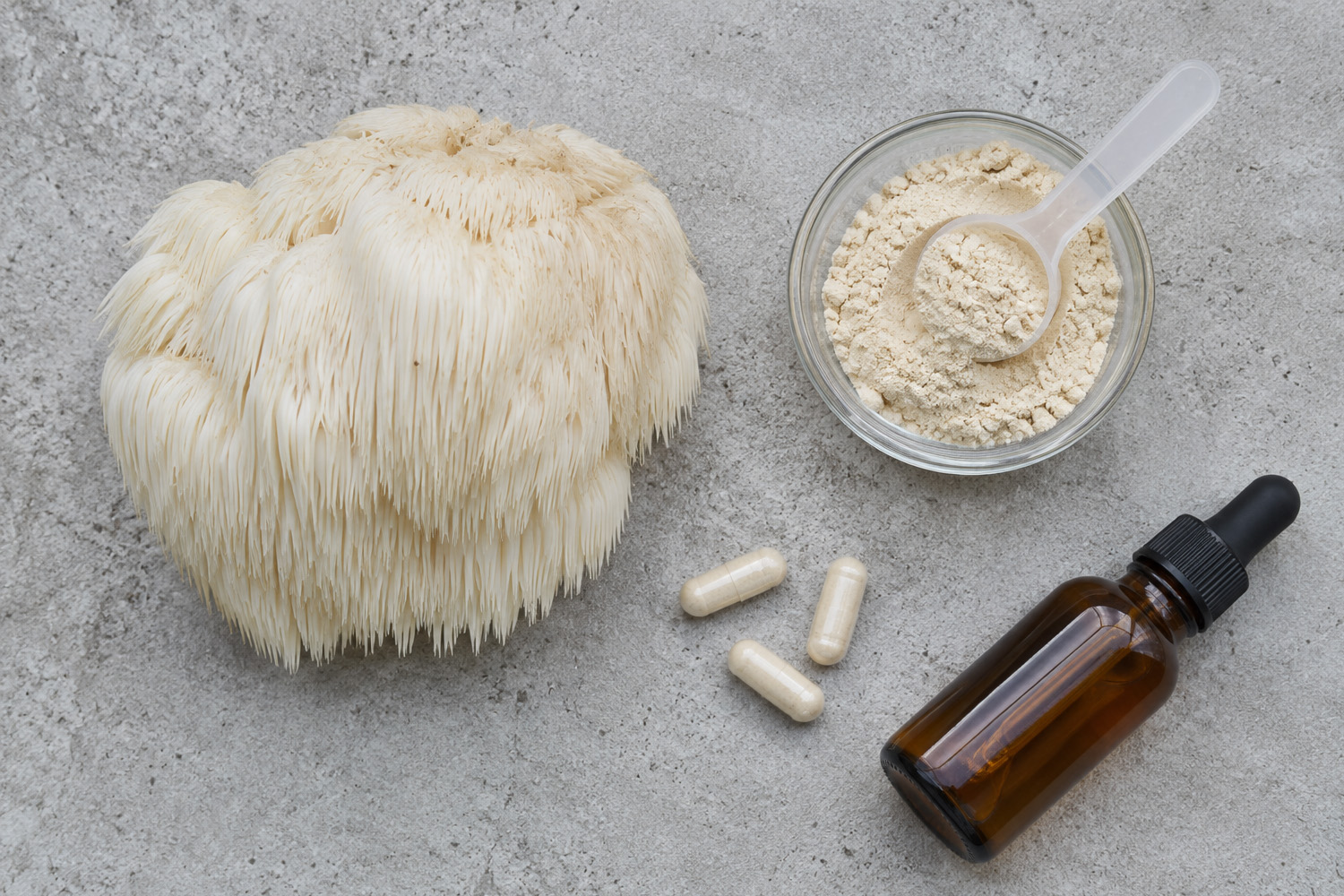
Avalon stocks three lion's mane products. A pouch of loose powder, a dropper bottle of liquid extract, and a jar of 120 capsules. All three are made from the fruiting body of Hericium erinaceus, no mycelium grown on grain. But the concentration is wildly different: the powder contains 5% polysaccharides, while the extract and the capsules contain 30%. That is a sixfold gap. Why, and does it actually matter?
Hericenones and erinacines
Lion's mane contains two groups of compounds that researchers find interesting. Hericenones come from the fruiting body. Erinacines come from the mycelium, the underground network. In cell studies, both stimulate the production of nerve growth factor (NGF), a protein that helps nerve cells grow and repair. An Australian lab showed in 2023 under super-resolution microscopy that lion's mane extract enlarged the growth cones of nerve cells in mice.
Sounds impressive. But nearly all of that research was done in cells or in rodents, not in people. The handful of human studies are small. A Japanese trial gave 30 older adults with mild memory complaints 3 grams a day for 16 weeks and found improvement on cognitive tests. A more recent crossover study in 18 healthy young adults found no significant effect on memory or mood. So something is going on, but what exactly, and for whom, honestly, nobody knows yet.
The powder: 100 grams, 5% polysaccharides
The loose powder is a full-spectrum extract of the fruiting body, drawn with water and ethanol. One teaspoon is roughly 1.5 grams, so a pouch of 100 grams lasts about two months of daily use.
It tastes mild and faintly nutty. You will barely notice it in coffee or a smoothie. And that is exactly who this form is for: people who already have a morning drink and just want to stir something in without making it a whole project.
The downside? Concentration. At 5% polysaccharides, your 1.5-gram serving delivers roughly 75 milligrams of polysaccharides and beta-glucans. Compare that to the capsules or the liquid extract and you see why some users take more. Note: this product is currently out of stock.
The liquid extract: 30 ml in a dropper bottle
The Foodsporen drops go a clear step further. A triple extraction with water and alcohol produces an 8-to-1 ratio, meaning 8 grams of fresh fruiting body went into every gram of extract. The result is 30% polysaccharides. The formula also includes cinnamon and vitamin B3.
Ten drops contain 830 mg of lion's mane. The recommended dose is five drops twice a day, under the tongue or mixed into water. One bottle lasts about a month at that rate. The dropper bottle is made of MIRON violet glass, which shields the contents from light degradation.
We at Avalon get asked a lot whether drops work faster than capsules. The honest answer is that no one has tested this in humans. Sublingual absorption bypasses the stomach in theory, but whether that makes a real difference for these particular compounds is anyone's guess. Pick the drops if you want easy dose adjustment or if swallowing capsules is not your thing.
The capsules: 120 pieces, 400 mg each
The McMyco capsules contain 400 mg of lion's mane extract each, also from 100% fruiting body with the same water-and-ethanol extraction. Concentration: 30% polysaccharides, same as the liquid. Two capsules a day is the recommended dose, and a jar lasts two months.
No taste, no measuring, just two capsules with a meal. That is it.
The capsules are vegetarian. Excipients are magnesium citrate and silicon dioxide, nothing unusual for a food supplement.
So which one do you pick?
Three forms, same mushroom, but not the same concentration. The powder sits at 5% polysaccharides. The extract and capsules sit at 30%.
Here is how we at Avalon would put it. If you want simplicity and a consistent dose, go with the capsules. If you want to adjust the dose yourself, the drops are more flexible. And the powder suits anyone who already has a morning smoothie or coffee ritual and just wants to toss lion's mane in as an ingredient.
But do not choose on price per package. The capsules cost more per jar, yet they last two months and contain six times the active compound per gram compared to the powder. Per milligram of polysaccharide, they are actually the better deal!
The thing is, there is no proven health benefit that requires one specific form over another. The science simply is not there yet. Choose what fits your your routine and do not expect miracles.
Safety
Lion's mane has been well tolerated in small clinical trials. The most commonly reported complaints are mild stomach discomfort, slight bloating and occasional skin rash. If you take medication for diabetes or blood thinners, talk to your doctor first. The same applies for autoimmune conditions or pregnancy. And yes, a mushroom allergy is a straightforward reason to avoid it.
Long-term data is largely missing. The longest study ran for 16 weeks. We do not find that alarming, but we do think it is worth saying plainly: no one knows what years of daily use does.
Want to learn more about medicinal mushrooms in general? Read our introduction to medicinal mushrooms. The full medicinal mushrooms category at Avalon also includes chaga, reishi and cordyceps.