

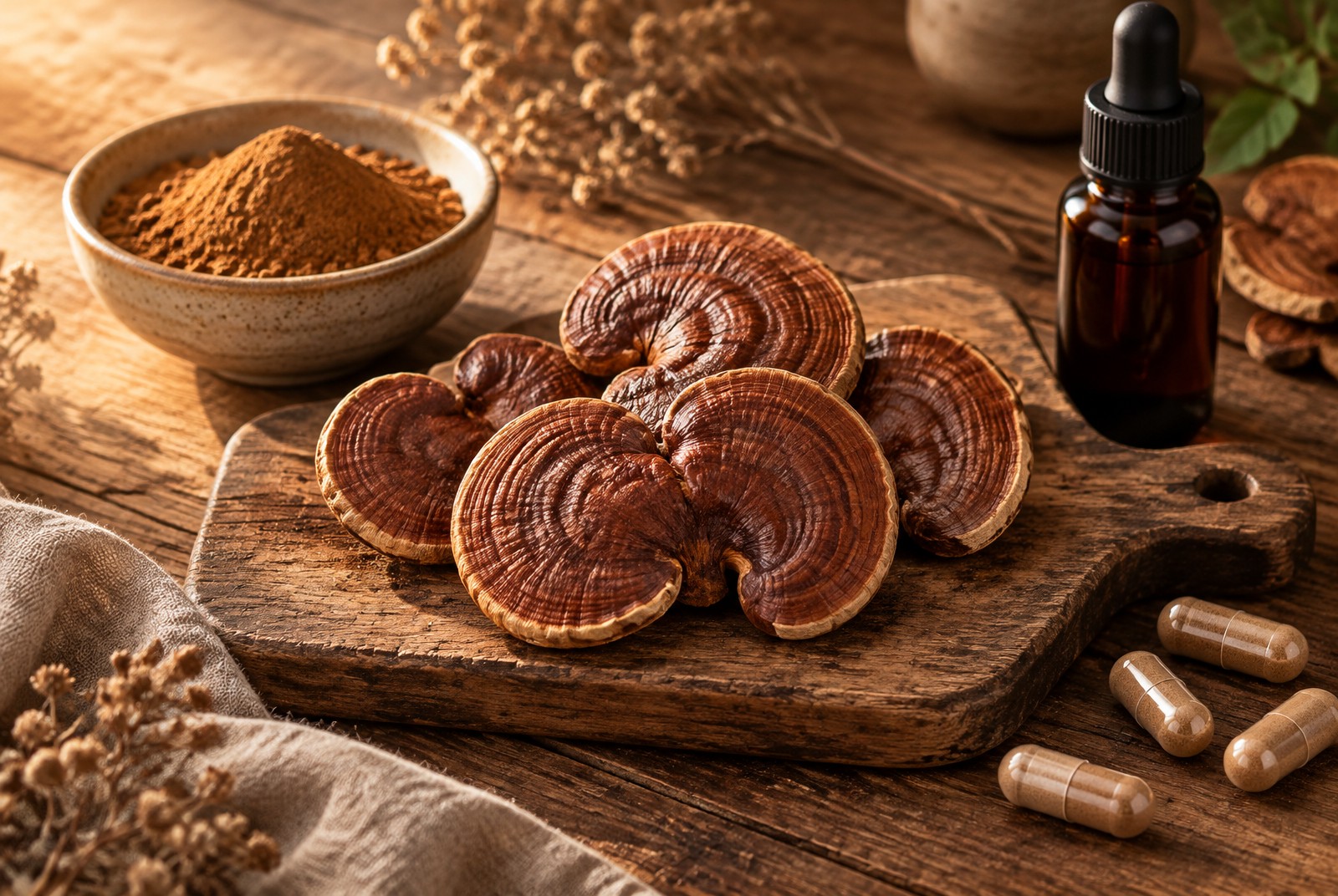
Pick up any mushroom supplement and there is a good chance reishi is on the label. Ganoderma lucidum, its Latin name, has been part of traditional Chinese medicine for over two thousand years. That sounds impressive. But what is actually inside this mushroom, and does that ancient reputation hold up?
We sell three reishi products at Avalon: loose powder, liquid extract and capsules. This article covers what is in them, what science says so far, and how the three forms differ.
Two groups of compounds
Reishi contains hundreds of compounds, but researchers focus on two groups. The first are triterpenoids, particularly ganoderic acids. These give the mushroom its bitter taste. If you taste bitterness in reishi tea or extract, you are tasting triterpenoids. In laboratory studies, these compounds show anti-inflammatory and antioxidant activity.
The second group are polysaccharides, including beta-glucans. These are long sugar chains that appear to activate the immune system in cell studies. The word "appear" is deliberate here, because the vast majority of that research was done in petri dishes and in mice. Not in people.
One practical point: the ratio between these two groups varies between products. Loose powder contains both but in lower concentrations. An extract concentrates them, so you get more per gram. Similar to what we saw with lion's mane, where the difference was sixfold.
What does the research actually say?
The honest summary: lots of lab work, very little good human research, and zero firm conclusions.
The most studied area is cancer. A Cochrane review looked at five randomised trials involving 373 patients. Reishi alone had no demonstrable effect on survival. As an addition to chemotherapy, there was a possible improvement in immune response, but the researchers called the evidence insufficient. That is not a damning verdict. It is simply not enough data.
Does it work for relaxation or sleep, then? Honestly, that is what most people buy it for at our shop, and it is the area with the least science behind it. There are hints from animal studies that certain triterpenoids have a calming effect, but good human sleep studies with reishi barely exist. That does not mean it does not work. It means nobody has properly studied it yet.
One small trial with 42 healthy subjects found that reishi extract raised antioxidant capacity in the blood and improved glutathione levels. Promising, but 42 people is not proof.
And yet, millions of of people worldwide have been taking reishi for centuries. That is not scientific evidence on its own, but it is not nothing either.
The three forms at Avalon
Just like with lion's mane, we sell reishi in three forms. The main difference is concentration and convenience.
Loose powder (100 grams)
The reishi powder is ground fruiting body. No mycelium on grain, no fillers. A teaspoon is roughly one and a half grams. Mix it into tea, coffee or a smoothie.
The taste is bitter, noticeably more so than lion's mane. Some people enjoy that in a strong coffee. Others do not. The concentration of polysaccharides and triterpenoids is lower than in the extract, but you do get the full spectrum of compounds.
Liquid extract (30 ml)
The extract is a concentrated tincture. You dose with a pipette, under the tongue or in a drink. The concentration of active compounds is higher here than in the loose powder. And yes, the taste is intensely bitter. In an espresso you will barely notice it.
Capsules (120 caps)
The capsules contain extracted reishi, comparable to the liquid extract but without the taste and with a clear dose per capsule. Easy to carry around, no fuss with pipettes or powder.
Which form is best? For most people the capsules are simply the easiest choice. If you want to work reishi into your morning drink, the powder is more fun. The extract is the one to pick if you prefer flexible dosing.
How to take it
There is no officially established dose. In clinical studies, amounts ranged from one and a half to over five grams of dry extract per day. Most supplement brands recommend somewhere between one and three grams.
Start low and build up. One capsule a day for a week, then increase if you want. Your body needs to adjust, especially with mushroom extracts.
Taking reishi for relaxation? Then in the evening, about an hour before bed. As a general supplement, timing matters less. Most of our customers take it with breakfast.
What to watch out for
Reishi is well tolerated by most people. But there are a few things worth knowing before you start.
The most important one: there are case reports of liver damage from prolonged use of reishi powder. A medical report described a 61-year-old man whose liver values normalised after he stopped taking it. A specialised cancer centre in New York cites two cases of hepatotoxicity with the powder form. Reishi extract is considered possibly safe for up to a year, but for pure powder beyond a month caution is advised. Those are very few cases among millions of users, but it is fair to mention them.
Do you take blood thinners? Talk to your doctor. Reishi may slow blood clotting at high doses. Stop at least two weeks before any scheduled surgery. If you take blood pressure or diabetes medication, checking in with your doctor is sensible too.
Side effects that come up more often include dry mouth, mild stomach complaints and occasional itching. For most people nothing happens at all. But if something feels off, just stop and see whether it passes.
Want to learn more about the full medicinal mushrooms category? Our overview article explains what else falls under it!