

Same box, completely different story
At Avalon Magic Plants, we sell well over thirty different cubensis grow kits. Golden Teacher, McKennaii, B+, Thai, Mazatapec, you name it. They all work the same way: open the box, hydrate, put it in the bag, wait. A few weeks later you have mushrooms.
And then there is the Copelandia Hawaiian.
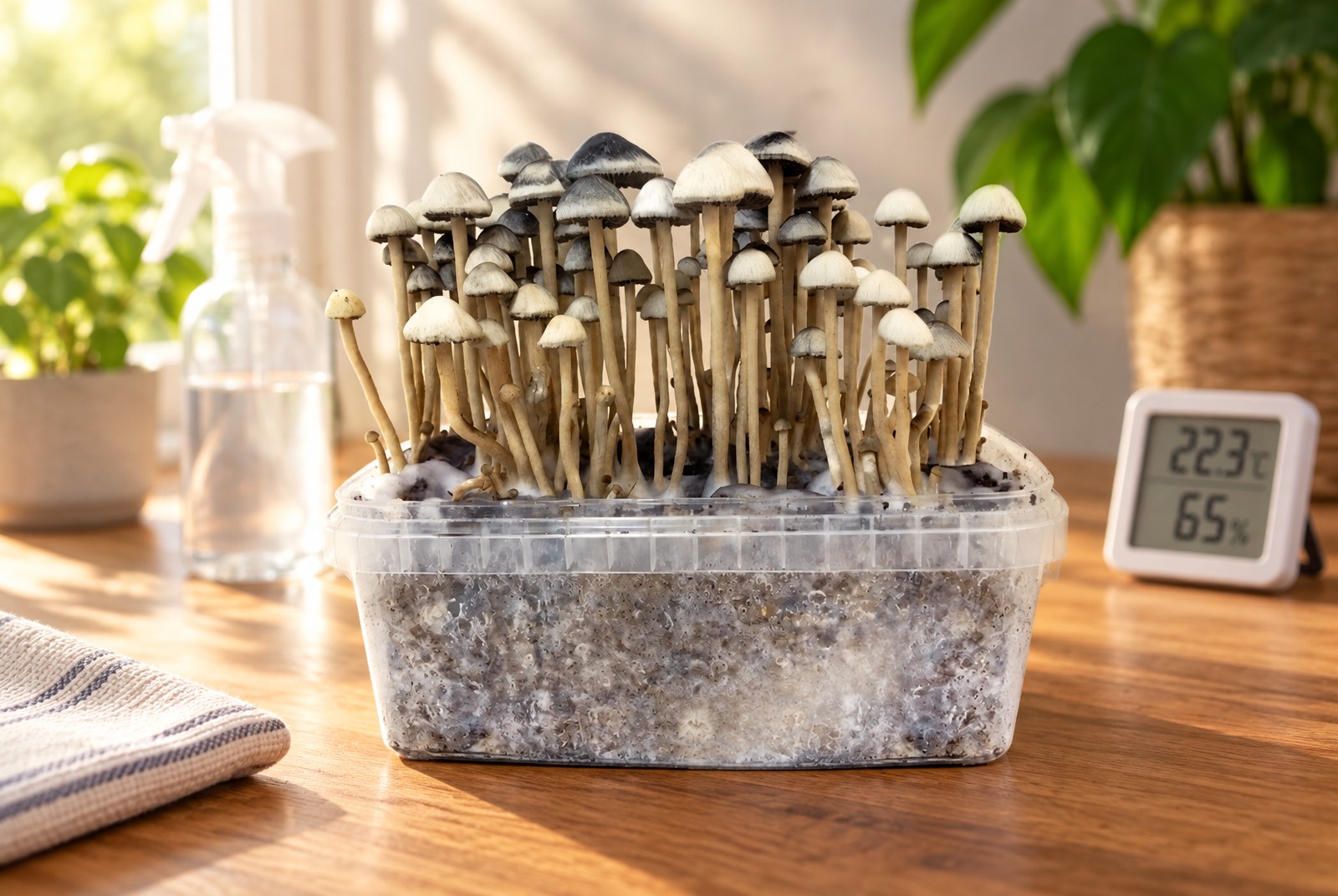
It is a 1200cc grow kit that looks exactly the same, but the moment you open it you realise this is an entirely different animal. Copelandia Hawaiian is a Panaeolus cyanescens, not even a Psilocybe. Different genus, different rules. We see it all the time in the questions we get: people treat their Copelandia kit like a cubensis kit, and then the first flush goes wrong.
Panaeolus cyanescens is not a Psilocybe
Sounds like a technicality, but it explains everything. Every cubensis kit in our shop is a Psilocybe cubensis variety. That species grows in tropical and subtropical climates on cow dung and is, honestly, pretty forgiving as a grower. Temperature a degree too low? Carries on. A bit too much water? It survives.
Panaeolus cyanescens is a different story. The species originates from tropical regions and grows on dung in warm, humid pastures. The mycelium is finer, the fruit bodies are smaller and more fragile, and the fungus reacts much more harshly to mistakes. Want more background on the species itself? We wrote about it before.
Four ways the growing process differs
The instructions that come with the Copelandia Hawaiian grow kit are separate for a reason. These are the four main points where it differs from a standard cubensis kit.
1. Thin substrate layer with a casing
With cubensis, the substrate sits firmly packed in the box. With the Copelandia kit you spread a thin layer of substrate, and on top of that goes a casing layer of soil. That casing retains moisture and helps trigger pinning. Sounds simple, but the the ratio matters: too thick and the mycelium cannot reach the surface, too thin and it dries out too fast.
2. Warmer
Cubensis does fine between 20 and 24 degrees Celsius. Copelandia wants it warmer: 21 to 26 degrees, and some growers swear by 24-25 as the sweet spot. Below 20 degrees, growth practically stops. But above 28, contamination risk rises fast, so the window is narrower than you are used to with cubensis.
3. High humidity, but no water on the mushrooms
This is where it goes wrong most often. Copelandia needs 90 to 95% humidity, same as cubensis really. The difference is in how sensitive the fruit bodies are. Cubensis survives a splash of water on its cap, Copelandia does not. Direct water on the pins or young mushrooms rots them. Spray the inside of the bag, not the substrate. And do it once or twice a day, no more.
4. Contaminates faster
Copelandia mycelium is finer and has less resistance against competing moulds. Where a cubensis kit with mild contamination sometimes just grows through it, Copelandia gives up. The mycelium and casing turn blue, and then it is over. Hygiene when opening and misting is not a recommendation here, it is a requirement.
First flush failed? Here is why
We get this question regularly. Someone has successfully grown three cubensis kits, buys a Copelandia, and the first flush produces nothing. In our experience, it almost always comes down to one of three things.
Too much water. People mist the Copelandia kit the way they are used to with cubensis, and then there is water sitting on the casing layer. That kills the pins. Can you see droplets hanging on the inside of the bag? Then humidity is high enough and you do not need to spray.
Too cold. A Copelandia kit on a windowsill in October does not work. The temperture needs to be stable above 21 degrees, and ideally around 24. A heat mat with a thermostat helps a lot.
Opened too often. Every time you open the bag to check, you lose moisture and potentially introduce contamination. Cubensis handles that better. With Copelandia: look through the plastic, only open when you need to mist, and wash your hands.
The effect is stronger than you think
This is the part that catches beginners off guard. Copelandia cyanescens contains roughly two to three times more psilocybin and psilocin per gram than an average cubensis. On top of that, the ratio is different: there is relatively more psilocin. Does that matter? Yes. Psilocin is what your body uses directly without conversion. That means a faster onset.
With cubensis you typically wait 30 to 45 minutes for the first effects. With Copelandia it can start within 15 to 20 minutes! And the intensity matches. Our rule of thumb at Avalon: dose Copelandia at a third to half of what you would take with cubensis. One gram of fresh Copelandia is already in the neighbourhood of two to three grams of fresh cubensis.
Feeling uncomfortable during a trip? A trip stopper is your safety net, regardless of the species.
What we carry in the shop
At Avalon you can go two ways with Copelandia. The Copelandia Hawaiian 1200cc grow kit is the easiest route: everything is included, you just need to follow the instructions. The Copelandia instructions, not the cubensis ones.
Experienced growers who want to make their own substrate and casing can work with the Copelandia cyanescens spore prints. We also have Jamaica and Goliath spore vials, both Panaeolus varieties.
New to mushroom grow kits and wondering whether to start with Copelandia? Start with a Golden Teacher. Seriously. It is more forgiving, the yield is more predictable, and you learn the basics without frustration. The Copelandia is there for when you have that down!