


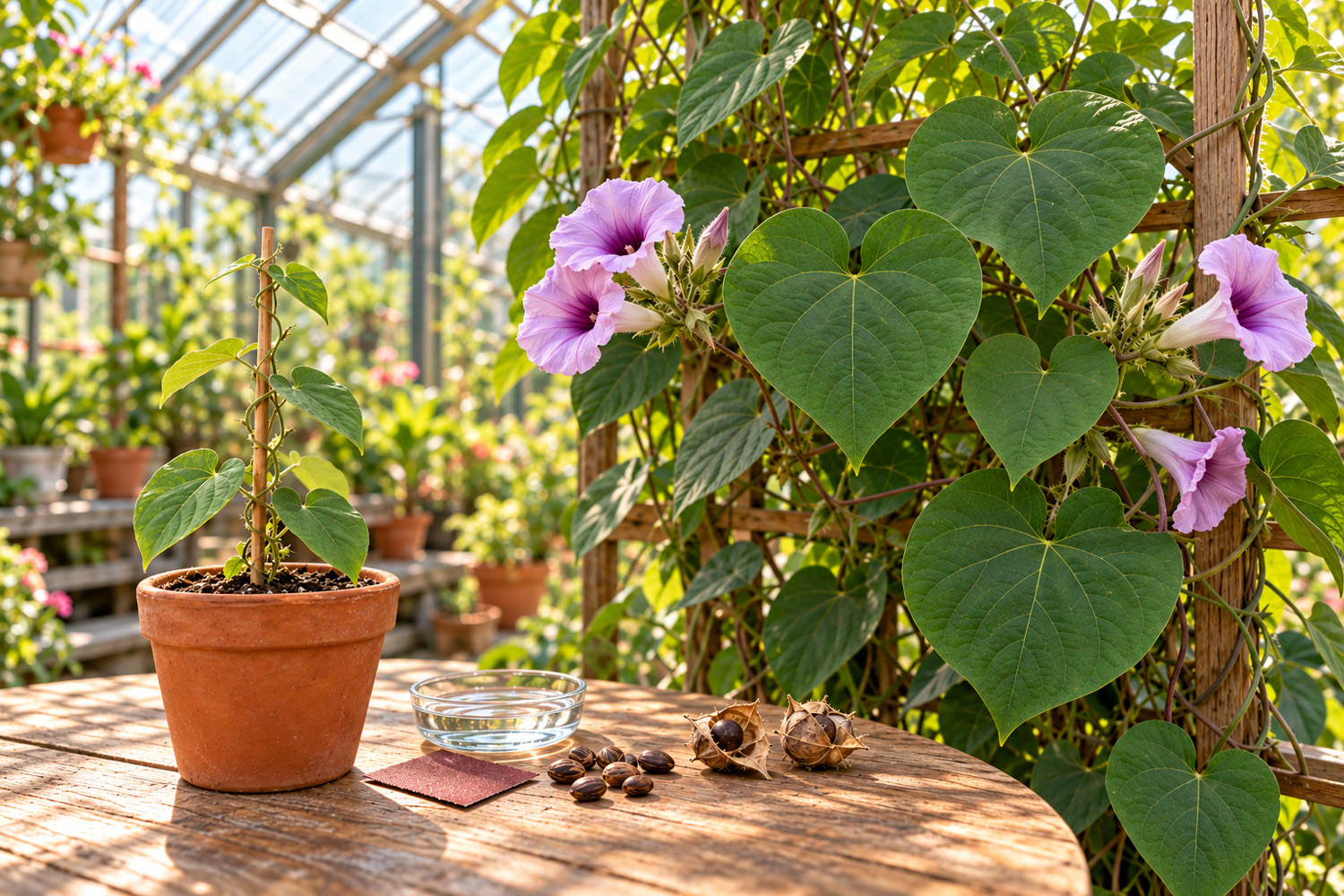
Hawaiian baby woodrose, a slow but striking climber
Hawaiian baby woodrose (Argyreia nervosa), like morning glory, belongs to the bindweed family (Convolvulaceae), but where morning glory is a fast annual, this is a woody, perennial climbing vine from India. It has large heart-shaped leaves with a silvery sheen underneath and lilac trumpet flowers. The dried seed capsules look like little wooden roses, which is where the name comes from. This guide explains how to germinate the seeds and raise the plant. You will find the seeds in our exotic seeds category, alongside the closely related Morning Glory Heavenly Blue.
Preparing the seeds: scarifying and soaking
Hawaiian baby woodrose seeds have a thick, hard coat that barely lets water through. Without treatment they hardly germinate. Lightly file the coat with a nail file or sandpaper until you just reach the lighter layer underneath, without damaging the core. Then soak the seeds for 24 to 48 hours in lukewarm water. Seeds that swell up are ready to sow.
Sowing: warmth is crucial
Sow in a warm spot at 25 to 30 degrees Celsius, for example on a heat mat. Place the seeds shallowly in a moist, free-draining seed mix. Germination is slow and uneven: expect 1 to 6 weeks, sometimes longer. Keep the mix moist but not wet, because too wet rots the seeds.
Growing on and support
Once the seedling has a few true leaves, give it plenty of light and warmth. Hawaiian baby woodrose is a vigorous climber, so provide a cane or frame in good time. During the growing season, water moderately and feed occasionally. The plant grows quickly once it gets going.
Overwintering
The plant is not frost-hardy and tolerates no frost. Bring it indoors before the first cold nights and keep it above 10 degrees. Water far less in winter, as the plant rests then. In a temperate climate you therefore keep Hawaiian baby woodrose as a house or greenhouse plant.
Flowering and seed capsules
In the tropics the plant flowers with lilac trumpet blooms and then forms the characteristic woody seed capsules. In a temperate climate it rarely flowers: that takes several years and plenty of heat. Most growers therefore keep Hawaiian baby woodrose mainly as a foliage plant.
Common mistakes
- Not scarifying the seed coat, so the seeds fail to germinate.
- Sowing too cold, which stalls germination.
- Too much water, which rots seeds or roots.
- Leaving the plant outside during night frost.
Want to understand the difference between these two well-known LSA seeds, read our article on the LSA difference between morning glory and Hawaiian baby woodrose.
Hawaiian baby woodrose seeds are sold as ornamental and collector's seed, not for consumption. Ordering is possible from age 18.
Frequently asked questions
How long do Hawaiian baby woodrose seeds take to germinate?
Usually 1 to 6 weeks, sometimes longer. Scarifying and soaking the seeds and a soil temperature of 25 to 30 degrees are essential here.
Is Hawaiian baby woodrose frost-hardy?
No, the plant is frost-tender. In a temperate climate you overwinter it indoors, above 10 degrees.
Can I grow Hawaiian baby woodrose as a houseplant?
Yes. With plenty of light, warmth and a support to climb, the plant does well as a house or greenhouse plant.
Why are my seeds not germinating?
Almost always an unscarified seed coat, a temperature that is too low, soil that is too wet or old seed. Scarify and soak the seeds and keep them warm.
What is the difference with morning glory for growing?
Morning glory is a fast annual you raise straight from seed. Hawaiian baby woodrose is a slow, woody perennial you have to keep warm and frost-free.


