

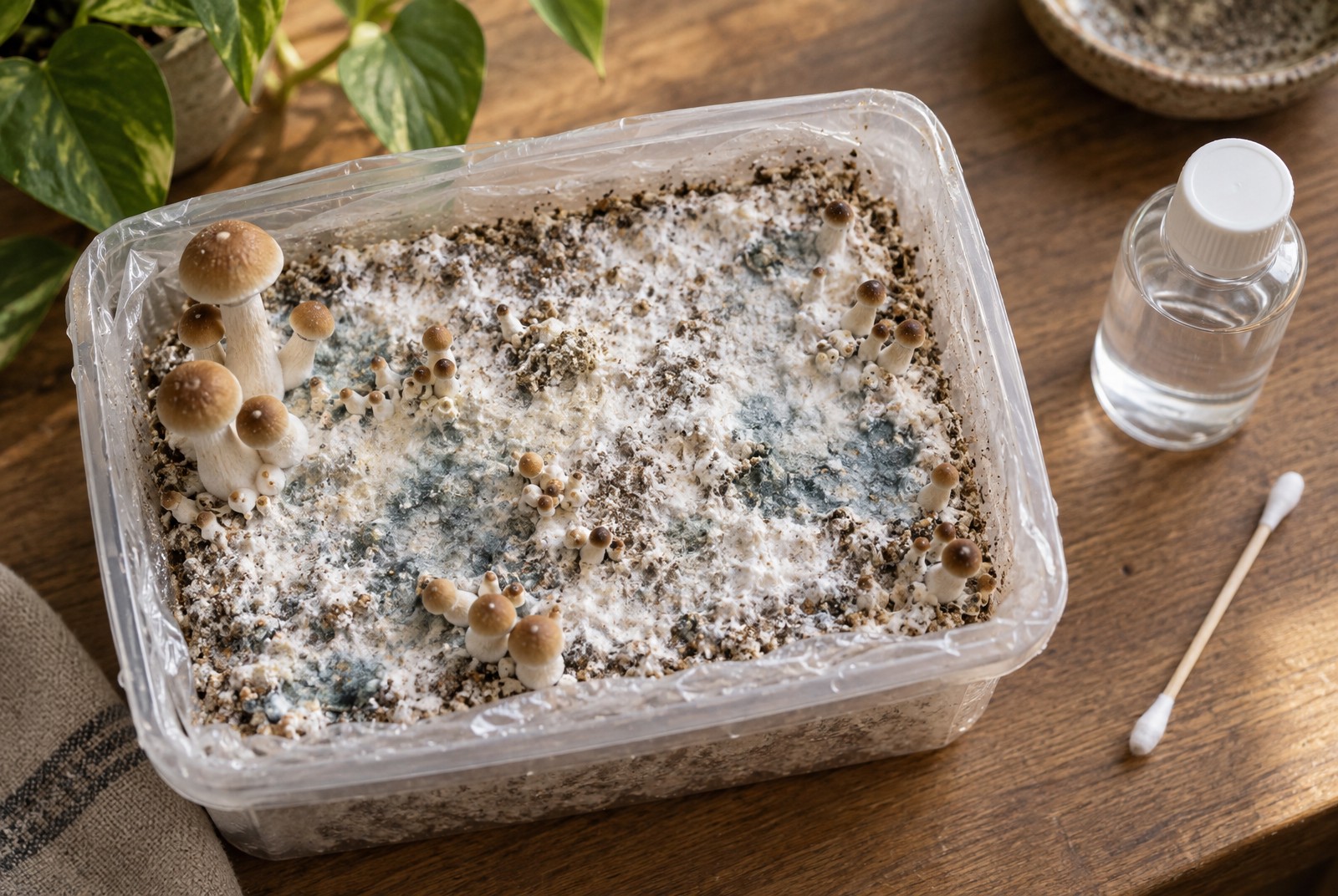
You open the box and your stomach drops
It happens to almost everyone who uses a magic mushroom grow kit for the first time. After a week or two, you lift the lid and something looks off. Discolouration. Patches. Something green, something blue, something you can't quite place. And then comes the frantic googling and the Reddit posts.
At Avalon Magic Plants, we get this question every single week: is this mould or is this normal? The answer is surprisingly straightforward once you know what to look for.
Blue is good news
The most common discolouration in a healthy grow kit is blue. Light blue, grey-blue, sometimes almost purple. And it is the exact opposite of a problem.
Blue patches happen because psilocybin oxidises. The active compound in magic mushrooms reacts with oxygen whenever the mycelium gets damaged, whether by touch, by water droplets landing on it, or just by airflow. Think of an apple turning brown after you cut it. The flesh isn't rotten, it's just reacting with the air.
Does this happen with every strain? Yes, every single one. Every Psilocybe cubensis variety we sell at Avalon shows bruising. Golden Teacher, B+, McKennaii, Cambodian, doesn't matter. The more psilocybin the mycelium contains, the quicker the blue colour appears. With stronger strains like McKennaii, you sometimes see it after the first misting.
The blue patch usually disappears within two to three days on its own. The mycelium recovers and just keeps growing. No action needed, other than misting more gently and handling the kit as little as possible.
The Q-tip test
Still not sure? There's a test that takes five seconds and works almost every time. Grab a clean cotton swab and gently dab the suspicious spot.
Colour on the swab? That's mould. Mould spores are powdery and leave pigment behind. No colour? That's bruising. Psilocybin oxidation sits inside the tissue itself and doesn't rub off.
We always recommend this as a first step. It saves people from tossing a perfectly fine kit for no reason.
Green is the real danger
Now for the bad news. Bright green in your grow kit is almost always Trichoderma, and Trichoderma is every mushroom grower's worst enemy. Growers call it the Green Monster for a reason.
Trichoderma starts white. That's what makes it tricky, because for the first day or two it looks exactly like healthy mycelium. But once it starts sporulating, it turns vivid green, and by that point it's too late. It can cover an entire kit in one to two days. And the moment you see green, spores are already airborne.
Can you save a kit with Trichoderma? No. Just no. Some forums claim otherwise, but in our experience it's a waste of time. Once it's green, the colony has penetrated too deep into the substrate. Seal the kit, throw it away outdoors, and don't open it inside your house.
Black, yellow and cobwebs
Trichoderma is the most common contaminant, but it's not the only one.
Aspergillus niger looks like finely ground black pepper scattered across the substrate. This is the most dangerous variant for your health because Aspergillus produces mycotoxins. Do not sniff it, don't open the kit indoors, dispose of it sealed. Aspergillus flavus is similar but yellow-gold to olive-green. Same rule applies: don't open, throw away immediately.
Cobweb mould looks different from what you might expect. It's grey and wispy, almost like cotton wool, and it can cover an entire surface overnight. But here is actually good news: cobweb is the only common contaminant you can sometimes treat. Spray it carefully with 3% hydrogen peroxide and the mould literally dissolves. That also confirms the diagnosis, because real mycelium doesn't react to it. Better air circulation helps prevent it from comming back.
Penicillium shows up as blue-green circular patches, often on grain or agar. It's less aggressive than Trichoderma, but the kit is compromised. If it appears after pins have already formed, yields might still be reasonable, but we wouldn't recommend consuming those mushrooms.
When to keep growing, when to stop
Honestly, with most contaminations the decision is simple. Get rid of it.
The exceptions are limited. Cobweb mould caught early can sometimes be treated with hydrogen peroxide and better ventilation. A small bacterial spot on the surface with improved airflow might stabilise. But Trichoderma that's turned green, any Aspergillus, and widespread contamination of any kind are always reason to throw the kit away.
And mushrooms growing next to a contaminated area? They're sitting on the same mycelium network and sharing the compromised substrate. We advise not using them, even if they look perfectly healthy.
A discarded block doesn't have to go in the bin, though. Bury it in a shaded spot in the garden. Sometimes it produces a surprise outdoor flush after a few weeks, where contamination has less of a chance.
Prevention: what actually works
We regularly get asked what the single most important factor is. Our answer is always the same, and it's not the brand of your grow kit. It's hygiene.
Wash your hands with soap before touching the kit. Not just a rinse, properly wash them. Use 70% isopropyl alcohol to wipe down your work surface. And the most important thing of all: open the kit as rarely as possible. Every time you lift that lid, spores get in.
Temperature matters too. Too warm (above 27 degrees) gives Trichoderma a head start over your mycelium. Keep it between 21 and 24 degrees, stable. Our article on temperature and humidity explains exactly how that works.
And never reuse substrate that was previously contaminated. Trichoderma spores survive for months.
Just start over
A failed kit feels frustrating. But it's not the end. Contamination happens to experienced growers too, not just beginners. Most customers who order a Golden Teacher grow kit or an XL version from us get at least two solid flushes. If you follow the basic rules, problems are actually quite rare!
Want to go over the fundamentals first? Our guide to your first harvest walks through the whole process. And if you've already harvested, read up on how to dry and store fresh mushrooms properly.