

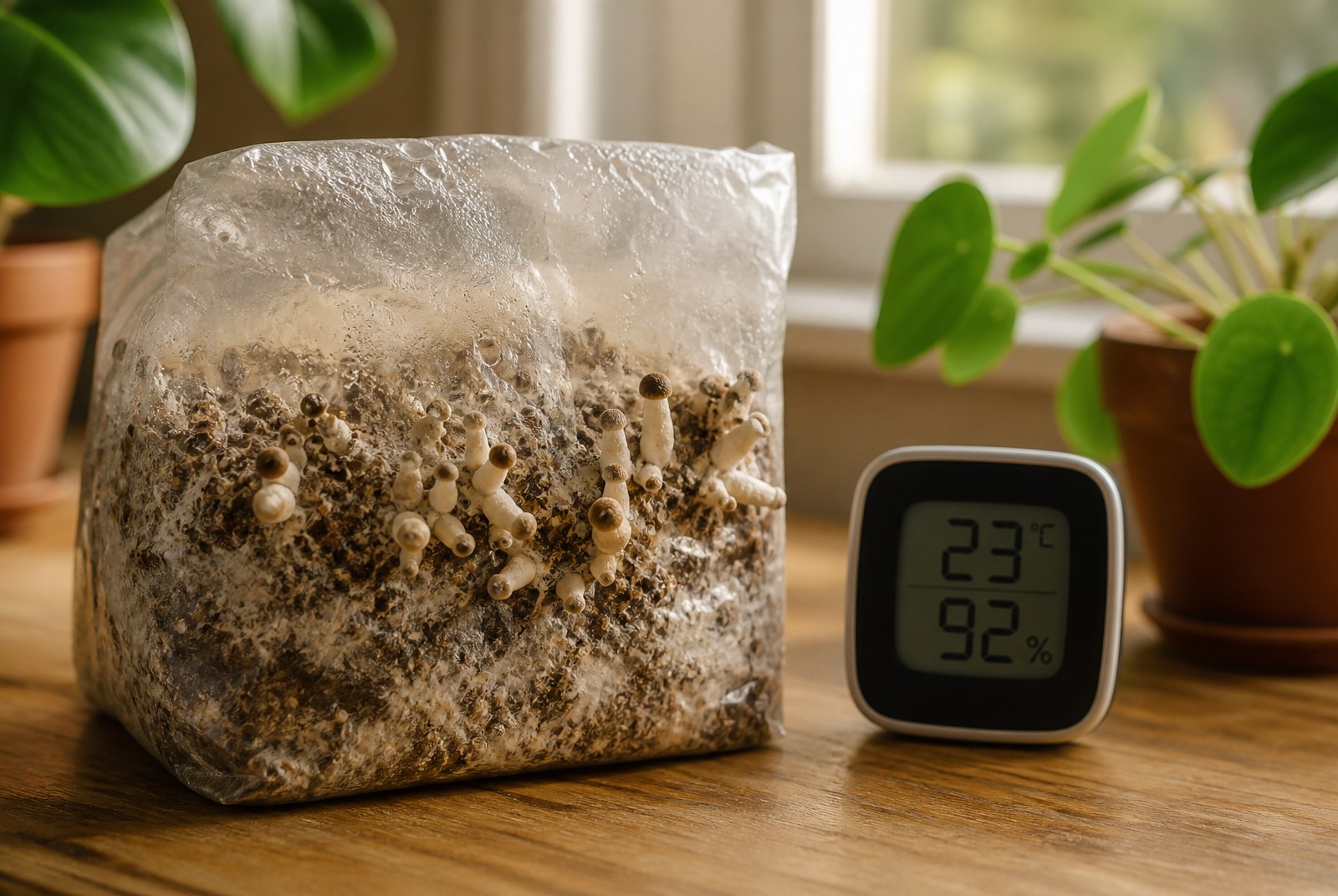
The difference between a disappointing first flush and a full canopy of mushrooms rarely comes down to the kit itself. It comes down to the room around it. A Psilocybe cubensis grow kit kept steadily at 23 °C produces up to twice the yield of the same kit in a room that swings between 26 °C during the day and 18 °C at night. Yet the growing environment is exactly the part most beginners underestimate.
At Avalon Magic Plants, we see daily questions from growers who follow every step correctly except their temperature, humidity or light schedule. This article breaks down the exact numbers for each growth phase, how to measure and adjust them, and five mistakes that can halve your harvest.
Temperature by growth phase: colonisation versus fruiting
Psilocybe cubensis goes through two distinct phases, each with its own temperature requirements.
Colonisation (mycelium takes over the substrate)
During colonisation, the white mycelium network spreads through the substrate. The ideal temperature sits between 24 and 27 °C (75 to 81 °F). At that warmth, the mycelium expands quickly and outcompetes potential contaminants like moulds and bacteria. Place the kit in a cupboard or on a shelf where the temperature stays consistent. Avoid windowsills: too hot from sunlight during the day, too cold from glass radiation at night.
Below 20 °C (68 °F), colonisation slows noticeably. Drop below 18 °C (64 °F) and the mycelium enters dormancy, halting growth entirely. Above 28 °C (82 °F), the advantage flips: bacteria multiply faster than mycelium, and the risk of Trichoderma (recognisable by green patches) increases sharply.
Fruiting (mushrooms form)
Once the substrate is fully white, the kit shifts to fruit formation. A slightly lower temperature works best now: 21 to 23 °C (70 to 73 °F). The optimum for Psilocybe cubensis is 23 °C (73 °F). That gentle drop compared to colonisation mimics the natural transition from summer to autumn, helping pinheads (the first tiny mushrooms) to form.
Consistency matters more than hitting an exact number. A kit sitting at a steady 22 °C (72 °F) day and night will outperform one that reaches 25 °C by afternoon and drops to 19 °C overnight. Place a digital thermometer next to your kit and record the extremes over 24 hours. If the swing exceeds 3 °C, find a more stable spot.
Humidity: measuring and adjusting
Mushrooms are roughly 90% water. Without sufficient humidity, young pinheads dry out before they can develop into full fruit bodies.
During colonisation, the relative humidity (RH) in the immediate environment of the substrate needs to be 95 to 100%. Most ready-to-grow kits handle this on their own through the sealed bag or lid. You have little to do in this phase beyond keeping the bag closed.
During fruiting, the required RH drops slightly to 85 to 95%. Open the bag according to the instructions and mist once or twice a day with clean water (preferably filtered or boiled and cooled). Mist the inside walls of the bag, not the mushrooms directly. A basic hygrometer (from around 5 euros) tells you exactly where you stand.
One critical threshold to know: if RH stays below 80% for an extended period, pinheads abort. You recognise this by small, dark brown knobs that stop growing. On the flip side, too much water leads to a waterlogged substrate, which becomes a breeding ground for bacteria. Fine mist is the goal, not a drench.
Light and photoperiod
Mycelium does not need light to grow. During the colonisation phase, the kit can sit in complete darkness. Light only becomes relevant at the transition to fruiting: it acts as a directional cue, since mushrooms grow towards the light source (positive phototropism).
Indirect daylight is ideal. Place the kit in a room with a window but out of direct sunlight. Direct sun heats the substrate, dries out the top layer and can damage the mycelium. A north-facing window, or a spot two metres from a south-facing window, works well.
No daylight available? A simple fluorescent tube or LED strip on a 12/12 schedule (12 hours on, 12 hours off) is enough. Use cool white light (6500K). Avoid UV lamps and heat lamps: these produce too much heat and radiation.
Light intensity does not need to be high. Normal room lighting is sufficient. What matters is the signal (light exists), not the strength.
Fresh Air Exchange (FAE) and CO2
Fresh Air Exchange, or FAE, is the factor growers forget most often. During colonisation, you want minimal air exchange: the sealed bag keeps humidity high and prevents contamination. But once the fruiting phase begins, that reverses.
Growing mushrooms breathe in oxygen and exhale CO2. In a sealed environment, CO2 accumulates, and high concentrations suppress fruit formation. The result: long, thin stems with tiny caps (the mycelium "reaches" for air) or no growth at all.
The fix is straightforward. Open the bag two to three times a day for about 30 seconds and gently fan with your hand (wearing gloves) to refresh the air. Some growers cut an extra hole in the bag and cover it with micropore tape: this allows air through while blocking spores and bacteria.
Avoid direct drafts. A fan blowing straight at the kit dries out the substrate within hours. Indirect air circulation in the room (a fan pointed the other way) is a better approach.
Five common environment mistakes
1. Placing the kit on a windowsill
Windowsills are temperature chameleons. During the day, sunlight can heat the substrate above 30 °C (86 °F). At night, glass radiation drops it below 15 °C (59 °F). That 15-degree swing is devastating. Place the kit on a shelf or cupboard against an interior wall, away from windows and radiators.
2. Over-misting
Enthusiastic growers sometimes mist four or five times a day. The substrate becomes waterlogged, the bottom of the kit sits in a puddle, and bacteria thrive. One to two light mists per day on the inside walls of the bag is enough. If water pools at the bottom of the bag, tilt the kit gently and pour the excess out.
3. Not opening the bag during fruiting
Some growers keep the bag fully sealed even after pinheads appear. CO2 levels climb, mushrooms form long stems with tiny caps, or they stop growing altogether. Open the bag as instructed and provide daily air exchange.
4. Pointing a fan directly at the kit
Fresh air is necessary, but a fan blowing directly at the kit dries the substrate surface within hours. Pinheads abort, and the top layer forms a dry crust that blocks new mushrooms from pushing through. Use indirect airflow in the room instead.
5. Not measuring the temperature
"Room temperature" is a vague concept. In a typical home, temperatures range from 16 °C (an unheated bedroom in winter) to 28 °C (an attic room in summer). Without a thermometer, you are guessing. A digital thermometer with min/max function costs under 10 euros and prevents weeks of uncertainty.
Which grow kit suits your environment?
Not every Psilocybe cubensis strain responds the same way to environmental variation. The Golden Teacher FreshMushrooms Grow Kit is known for its tolerance: this strain forgives minor temperature fluctuations better than most other varieties. For beginners trying their first kit in a room without precise temperature control, it is a logical choice.
Growers with more experience and tight environmental control can opt for the Golden Teacher XL Grow Kit (2100cc): more substrate, more yield, but also more sensitivity to mistakes. The B+ FreshMushrooms Grow Kit is another beginner-friendly option. The B+ strain produces large mushrooms and handles slightly lower temperatures (down to 20 °C) without stalling.
For larger volume with the same reliability, the B+ XL Grow Kit (2100cc) offers the space. Browse the full range in the Avalon Magic Plants shroomshop.
Frequently asked questions
What is the best temperature for a magic mushroom grow kit?
It depends on the phase. During colonisation: 24 to 27 °C (75 to 81 °F). During fruiting: 21 to 23 °C (70 to 73 °F), with 23 °C as the optimum for Psilocybe cubensis. Stability matters more than hitting an exact number.
How high should the humidity be?
During colonisation, 95 to 100% (the sealed bag handles this). During fruiting, 85 to 95%. Mist the inside of the bag once or twice daily with clean water. If RH drops below 80% for too long, pinheads abort.
Does my grow kit need light?
Not during colonisation. During fruiting, yes: indirect daylight or a fluorescent lamp on a 12/12 schedule is sufficient. Direct sunlight is harmful.
Why do my mushrooms grow long stems with tiny caps?
This points to too much CO2 and too little fresh air. Open the bag two to three times a day and provide air exchange. The mushrooms "reach" for oxygen when CO2 levels are too high.
Can I use a heating mat?
Yes, but with caution. Place the mat under the kit with a towel in between as a buffer. Measure the temperature at the substrate, not the mat itself. Without a buffer, the bottom temperature can exceed 30 °C, which kills mycelium.