

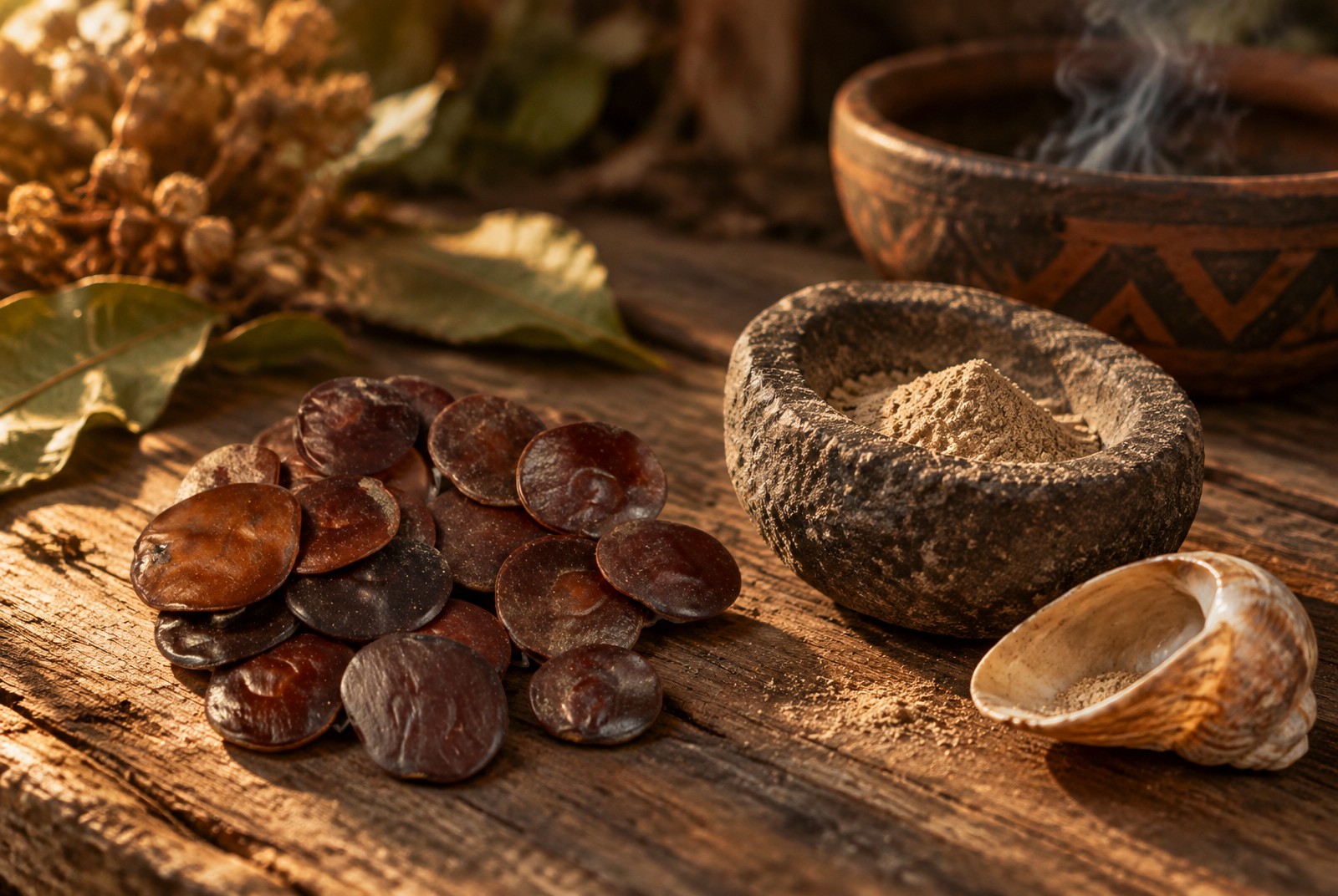
Snuff trays from 1200 BC
Along the coast of Peru, archaeologists have dug up stone trays and bone tubes that were used to inhale powdered seeds. The finds go back over three thousand years. In northern Argentina, at the Inca Cueva site, puma-bone pipes lay alongside Anadenanthera beans. Someone was snuffing this powder four millennia ago.
The tree behind all of it is Anadenanthera peregrina, a tall species native to the Caribbean, the Orinoco basin and parts of Brazil. Its flat, dark seeds are the raw material for yopo, one of the oldest documented psychoactive snuffs on the continent. We at Avalon Magic Plants stock the dried seeds in our ayahuasca section, but yopo's story is entirely its own.
How yopo powder is made
The traditional preparation starts with the seed pods. Once they ripen and darken, the flat beans inside are removed and toasted over heat until they pop. That cracking sound means the hard outer husk has loosened. Remove the husks, and you are left with the kernels.
Now it gets interesting. The kernels are ground with a mortar and pestle into a fine powder. But raw seed powder alone won't do much through the nose. The key step is adding calcium hydroxide, made from burned shells or wood ash. This alkaline component raises the pH, converting the active compounds into their freebase form so they can pass through the nasal membranes.
Does the type of ash matter? It does. The Piaroa people in Venezuela traditionally burn specific tree barks and mix the ash into the seed powder. Other groups use crushed snail shells or calcite. The result is a dough that gets dried over low embers, then crumbled into the the fine snuff you actually inhale.
The delivery method is just as specific. Y-shaped tubes, carved from bone or wood, let someone else blow the powder deep into your nostrils. Self-administration tools exist too, but the traditional practice almost always involves two people. If you have ever seen the instruments used for rapé, the resemblance is immediate!
Bufotenine runs the show
Most people who hear "yopo" think DMT. Fair enough. The Anadenanthera genus is famous for its tryptamine content, and DMT gets all the press. But when you look at the actual numbers, the picture shifts.
One gram of Anadenanthera peregrina seeds contains roughly 74 mg of bufotenine. DMT? About 1.6 mg. 5-MeO-DMT sits even lower, around 0.4 mg. These figures come from ICEERS and vary by tree, season and seed maturity, but the ratio is consistent. Bufotenine is the dominant alkaloid by a wide margin.
And this is where it matters for the experience. When you snuff yopo, bufotenine absorbs readily through the nasal mucosa. DMT and 5-MeO-DMT are actually poorly absorbed that way. So the compound doing the heavy lifting is bufotenine, not DMT. We see a lot of confusion about this among our customers, and honestly, the scientific literature did not help. Early analyses sometimes used extraction methods that accidentally excluded bufotenine from the results, making DMT look more important than it is.
How yopo compares to ayahuasca
Both involve tryptamines. Both come from South American plant traditions. But the experience is completely different.
Ayahuasca is a drink. It combines a DMT source (usually chacruna or chaliponga) with a vine like Banisteriopsis caapi that contains MAO inhibitors, making the DMT orally active. Onset takes thirty to sixty minutes, and the experience lasts four to six hours.
Yopo goes through the nose and hits in seconds. Peak effects arrive within five to twenty minutes, and the whole thing wraps up in two to three hours. No MAO inhibitor involved, and the primary compound is bufotenine rather than DMT. It is a shorter, more intense window, and the physical experience is markedly different too. Nausea and heavy nasal discharge are common with yopo, where ayahuasca's nausea is gastrointestinal.
The best comparison is actually between yopo and rapé. Both nasal, both use plant ash, both involve a moment of sharp physical discomfort followed by clarity. But rapé is primarily a tobacco preparation, while yopo is a tryptamine one.
What you should know before trying yopo
Yopo is not gentle. The insufflation itself can be painfull, and the first ten minutes often bring watering eyes, a burning nose and an urge to sneeze or retch. This is normal and passes, but first-timers are regularly caught off guard.
Start with the equivalent of one or two seeds. Traditional doses go up to four or five, but working up gradually is the only sensible approach. And never combine yopo with MAO inhibitors such as Syrian rue or Banisteriopsis caapi without thorough research. Mixing tryptamines with MAOIs changes the pharmacology in ways that can be overwhelming or dangerous.
On legality, the situation varies by country. The seeds themselves are a botanical product, but some of the alkaloids they contain are scheduled substances in certain jurisdictions. Check your local laws before ordering.
We stock Anadenanthera peregrina seeds (10 grams) in our shop. Exploring the broader family of South American ethnobotanicals? Have a look at our full ayahuasca and entheogen collection.