
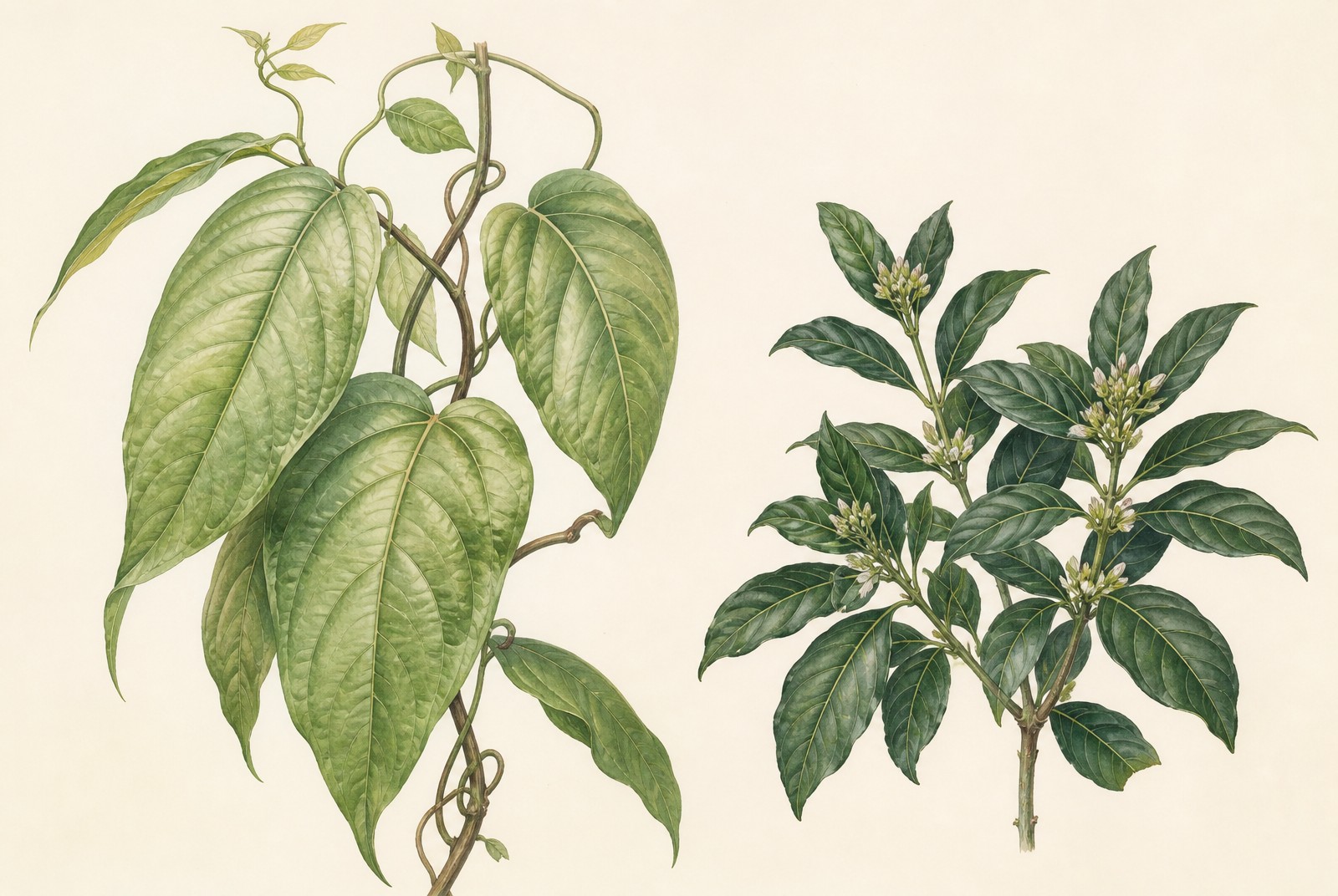
Two plants supply the DMT in traditional ayahuasca brews. Psychotria viridis, known as chacruna, dominates in Peruvian and Brazilian ceremonies. Diplopterys cabrerana, known as chaliponga or chagropanga, is the preferred admixture in Colombian and Ecuadorian yagé. Both are combined with Banisteriopsis caapi, but their leaf chemistry diverges in one critical respect: chaliponga produces three tryptamine alkaloids where chacruna produces one.
Two plant families, two ecological roles
Chacruna belongs to the Rubiaceae, the coffee family. It is a shrub that thrives in the shaded understorey of tropical rainforest, typically reaching two to three metres in height. Christiaan Hendrik Persoon first described the species in 1779, but Western science paid it little attention until Richard Evans Schultes and Dennis McKenna documented its ethnobotanical role in the 1960s and 1970s. We wrote a separate article about the chacruna plant, from leaf cutting to botanical collection.
Chaliponga is a woody climbing vine from the Malpighiaceae family. It grows in the canopy layer of lowland rainforest across Brazil, Colombia, Ecuador and Peru, and can reach considerable lengths as it winds through the treetops. Where chacruna is a compact understorey shrub, chaliponga needs vertical support and open canopy light to develop fully. Its leaves are noticeably larger and lighter green than those of chacruna.
The alkaloid split: one tryptamine versus three
Chacruna leaves contain N,N-dimethyltryptamine (N,N-DMT) and traces of N-methyltryptamine (NMT). Analytically, the DMT content varies widely depending on harvest time, season and drying method. McKenna, Callaway and Grob measured concentrations between 0 and 17.65 mg per gram of dried leaf across 37 Brazilian samples, with most clustering around 10 mg/g. Peak concentrations occur at dawn and dusk.
Chaliponga leaves contain not just N,N-DMT but also 5-MeO-DMT (5-methoxy-N,N-dimethyltryptamine) and bufotenine (5-HO-DMT). The total DMT content ranges from 1.7 to 17.5 mg/g of dried leaf. In addition, trace amounts of N-methyltetrahydro-β-carboline appear in the leaves and stems. The presence of 5-MeO-DMT is the key distinction: it is a potent tryptamine with effects that differ qualitatively from N,N-DMT, being described as more somatic and less visual.
The practical implication of this triple-alkaloid profile is not simply "more potent." 5-MeO-DMT affects serotonin receptors differently from N,N-DMT and tends to produce an experience that is felt in the body rather than seen with the mind's eye. Bufotenine, although present only in trace amounts, may contribute to the somatic intensity that practitioners associate with chaliponga brews. These three compounds together create a cocktail that is chemically distinct from the single-alkaloid profile of chacruna.
For collectors and researchers, the harvest window also matters. Studies on P. viridis show that DMT levels peak at dawn (about 8.97 mg/g) and dusk (about 9.52 mg/g), dropping during the middle of the day. Whether the same diurnal pattern holds for D. cabrerana has not been studied as thoroughly, but the variability underlines that a single concentration figure rarely tells the whole story.
A side-by-side comparison:
| Chacruna (P. viridis) | Chaliponga (D. cabrerana) | |
|---|---|---|
| Family | Rubiaceae (coffee family) | Malpighiaceae |
| Primary alkaloid | N,N-DMT | N,N-DMT |
| Secondary alkaloids | Trace NMT only | 5-MeO-DMT, bufotenine, trace NMT |
| DMT range (dried leaf) | 0 - 17.65 mg/g | 1.7 - 17.5 mg/g |
| Growth form | Understorey shrub, 2-3 m | Canopy-climbing vine |
| Primary region of use | Peru, Brazil | Colombia, Ecuador |
Different peoples, different names
The Shipibo-Conibo and Asháninka peoples of Peru use chacruna as their standard admixture. The Quechua name chacruna comes from the verb chaqruy, meaning "to mix," a direct reference to the plant's role in the brew. In Peru and Brazil the resulting drink is called ayahuasca.
In Colombia and Ecuador, the Camsá, Inga, Siona and Cofán peoples work with chaliponga instead. They call the plant chagropanga or oco-yajé and refer to the brew as yagé or yajé. The difference is not merely botanical: ceremony structure, songs (icaros versus cantos) and preparation methods all vary between the two traditions.
Neither plant is interchangeable with the other in the eyes of traditional practitioners. Colombian curanderos describe chaliponga as producing visions that are longer and more intensely coloured. Peruvian ayahuasqueros regard chacruna as more predictable and easier to work with ritually. These are cultural observations, not pharmacological absolutes, but they do align with the known difference in alkaloid profile.
Why the vine matters
Neither chacruna nor chaliponga produces effects when eaten on its own. The enzyme monoamine oxidase (MAO) in the human gut breaks down DMT before it reaches the bloodstream. Banisteriopsis caapi contains the β-carboline alkaloids harmine, harmaline and tetrahydroharmine, which act as reversible MAO-A inhibitors. By temporarily blocking that enzyme, the vine allows DMT (and any 5-MeO-DMT present in chaliponga) to pass into the central nervous system.
This pharmacological synergy between vine and leaf is one of the most studied examples of ethnobotanical knowledge. B. caapi itself comes in several varieties. At Avalon Magic Plants we carry both the red vine (rojo) and the yellow vine (cielo). You can read more about the vine in our article on growing Banisteriopsis caapi.
Collecting and storing the dried leaves
Both chaliponga leaves and chacruna leaves are available as dried botanical specimens. For long-term preservation, store them in a sealed container in a cool, dark and dry place. Exposure to heat, light and humidity degrades the alkaloid content over time. Vacuum-sealed bags inside an opaque container offer the best protection.
At Avalon Magic Plants, both species are sold exclusively as botanical specimens for collectors and educational purposes, not for consumption. Always consult the product disclaimer before ordering.
Frequently asked questions
What is the difference between ayahuasca and yagé?
Both terms refer to brews made with Banisteriopsis caapi as the base vine. Ayahuasca is the Quechua term used in Peru and Brazil, where the standard leaf admixture is chacruna. Yagé (or yajé) is the Colombian and Ecuadorian term, where chaliponga is the traditional admixture. The different leaf creates a different alkaloid composition in the final brew, which is why some practitioners insist on distinguishing the two rather than treating them as synonyms.
Is chaliponga "stronger" than chacruna?
The word "stronger" oversimplifies the difference. Chaliponga contains 5-MeO-DMT in addition to N,N-DMT, which changes the character of the alkaloid profile rather than simply increasing potency. The actual DMT concentration per gram varies widely within both species depending on harvest conditions.
Can Diplopterys cabrerana be grown outside the tropics?
As a tropical vine, D. cabrerana requires high humidity (above 70%), temperatures between 20 and 30 °C and strong vertical support. In temperate climates, a heated greenhouse with climbing structures is the minimum requirement. Growth is slow outside its native range.
What is the legal status of these plants?
In the Netherlands, the plant material itself is commercially available through smartshops and specialist retailers. France has specifically listed D. cabrerana and P. viridis as controlled plants since 2005. In most other European countries, the plants occupy a grey area: the dried leaves are not individually scheduled, but DMT as an extracted substance falls under narcotics legislation. Check the specific regulations for your country before ordering.