

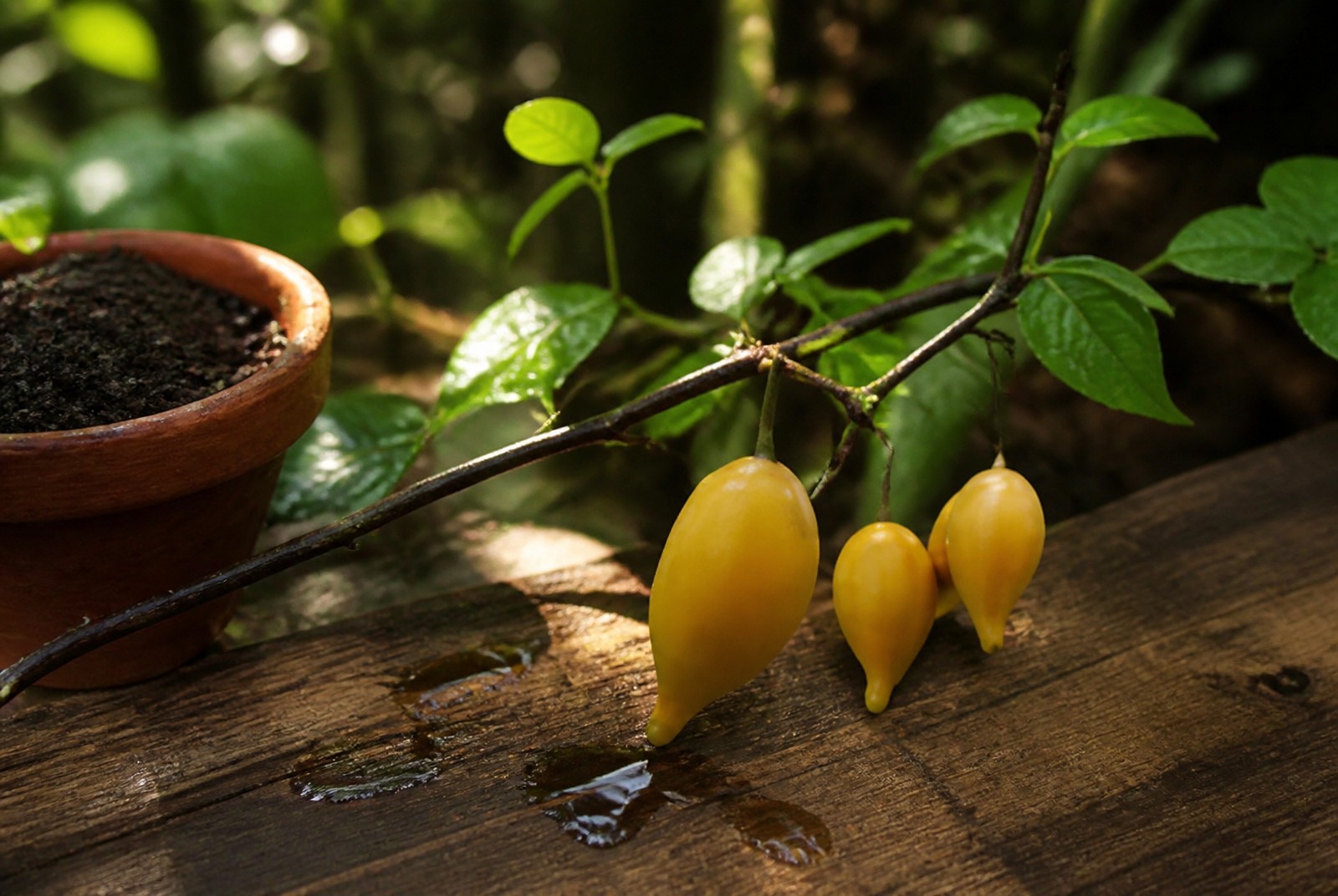
Ten fresh seeds, a warm corner and a few weeks of patience. That's the starting point. What follows is measured in years, not months. Tabernanthe iboga is one of the slowest growers you can take on as a hobby, and honestly, that's a large part of why it's worth growing.
A rainforest shrub from Gabon
Iboga grows wild in the dense rainforests of Central Africa, mainly Gabon, Cameroon and the Congo region. It belongs to the Apocynaceae family, the same family as Voacanga africana. In the wild, the plant reaches about four metres in height, with glossy dark green leaves, small pink-white tubular flowers and bright orange fruit.
Among the Fang, Mitsogo and Punu peoples of Gabon, iboga is known as the sacred wood. The root bark plays a central role in the Bwiti tradition, an initiation practice passed down through centuries. In smaller amounts, the bark is used for alertness during night ceremonies. Gabon has protected the plant as national heritage since 2000, and in May 2026 issued a decree tying the trade in wild iboga to government authorisation.
We at Avalon sell the seeds as a botanical collector's item. No root bark, no extracts, no health claims. Just the plant itself, for those who want to grow it.
Fresh seed or nothing
This is the first thing you run into. Iboga seeds lose their viability as soon as the seed coat dries out, and that happens fast. A few days of open air and the difference between a living seed and a dead one is invisible. Our advice: order your Tabernanthe iboga seeds and start soaking the same day they arrive.
Soak the seeds for 24 hours in lukewarm water, no hotter than 40°C. Some growers swear by a pre-treatment with hydrogen peroxide, 2% solution for one hour, to keep mould at bay. Not a bad idea. You can also add gibberellic acid to the soaking water for extra insurance, but it isn't necessary if the seeds are genuinely fresh.
Germination: 30 degrees, 80% humidity, hands off
Once soaked, sow the seeds in a sterilised medium. Bake a mix of peat and sand for half an hour at 120°C, let it cool and moisten it. Not wet. Moist. The seeds go half a centimetre deep.
Then you need three things. Heat, humidity and patience. Air temperature should sit consistently around 30-35°C. Cooler is possible, but germination takes longer and mould becomes more likely. A heat mat under the tray works well. Humidity needs to stay between 70 and 90%, so a propagator or plastic cover over the pot is pretty much non-negotiable.
Light should be indirect. No direct sunlight, especially in the first months. Iboga is an understorey shrub that grows in the shade of taller trees.
Does patience actually matter here? Yes. Germination takes four to twelve weeks, sometimes longer. You can keep the seed coat moist with a piece of wet cotton, or after a week or two carefully remove sections of the coat with a scalpel. But the the most important rule is simple. Don't give up when nothing has happened after six weeks.
The first three years: sixty centimetres
Once the seedling appears, you have a tiny plant that wants to grow. But slowly. Iboga grows in flushes rather than continuously. After three years, your plant will be roughly sixty centimetres tall. We sell over a hundred types of exotic seeds and iboga is by far the slowest!
The first potting mix for seedlings should be 90% coarse sand with 10% potting soil, and absolutely no manure or strong fertiliser. Only once the plant has a few sets of leaves can you start feeding lightly. Composted manure works better than liquid fertiliser.
Never expose the seedling to dry air before it has at least three pairs of leaves. Ventilation in the first months matters but should be gradual. Start with ten minutes a day in the first week and build up to one or two hours. Bring humidity down slowly to 60-70%.
What iboga asks of you long-term
Temperature is the bottleneck. Iboga stops growing below 15°C, drops its leaves below 10°C, and at 5°C the growing tips start dying. A single frost kills it. In northern Europe, that means indoors year-round unless you have a heated greenhouse.
The ideal range is 22-28°C, all year. Humidity of 70-90% is optimal, but the plant adapts. In dry air it sheds its leaves and grows new ones that are smaller and tougher. It survives, but it doesn't look great.
Aim for 50-70% shade, particularly in the early years. A mature plant tolerates more light, but direct sun causes yellowing and stress. Soil should be moist and well-drained, slightly acidic to neutral. Iboga is prone to root rot, so never let the soil get waterlogged.
And then there's the timeline. The juvenile phase lasts five to six years. The plant reaches maturity after seven to twelve. That's not a typo! Growing iboga is a project measured in years, not seasons. But now you know that going in.
Is it legal to grow iboga?
The plant itself is legal to possess and cultivate in the Netherlands. Ibogaine, the best-known alkaloid in the root bark, is not listed under the Dutch Opium Act. It sits in a grey area: not a registered medicine, but not prohibited either. The situation in Germany is similar. In Belgium and Denmark, ibogaine is explicitly scheduled under drug legislation.
We sell the seeds as botanical growing material. What you do with them is your own responsibility, but always check the legislation in your country.
Related plants
Iboga isn't the only ethnobotanical plant you can grow from seed. Banisteriopsis caapi and Psychotria viridis are also available as seeds and have similar tropical requirements. Voacanga africana, a direct relative from the same Apocynaceae family, is considerably easier to grow and a good starting point if you want to practise with tropical seedlings.
Of all these plants, iboga is the hardest and the slowest. If you're at peace with that, it's a fasinating plant to live with.