


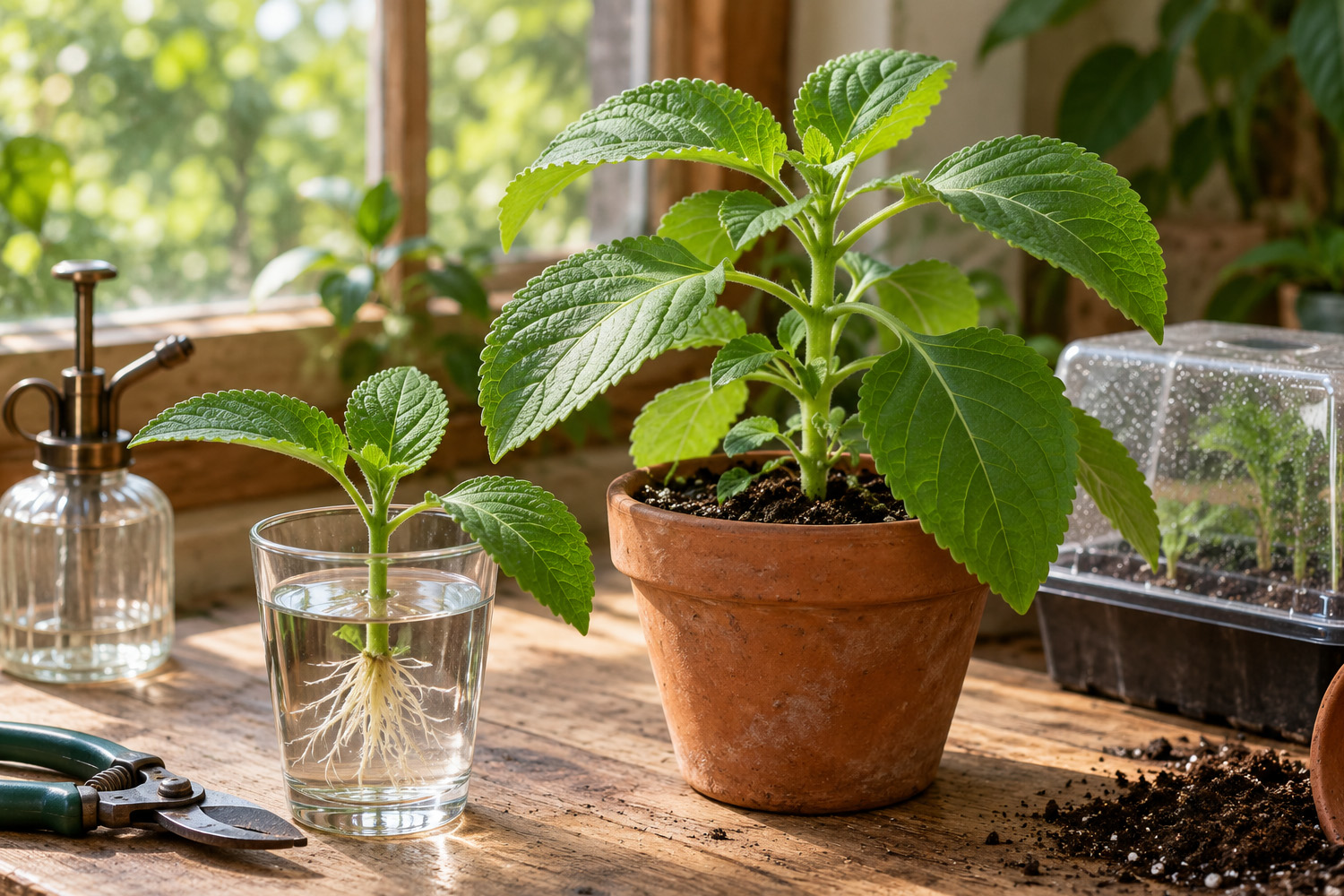
Salvia divinorum is almost always grown from a cutting. The plant rarely sets seed, and when it does, that seed usually won't germinate. The good news: a cutting takes root easily once you get humidity, light and temperature right. Below you'll find, step by step, how to root, pot and care for a cutting, plus the mistakes most growers make.
What kind of plant is Salvia divinorum?
Salvia divinorum belongs to the mint family (Lamiaceae), alongside basil, oregano and garden mint. In the wild it only grows in a handful of humid ravines in the Sierra Mazateca of Oaxaca, Mexico. It stays mild there all year, light filters through the forest canopy and the air is constantly moist.
That origin explains nearly every care rule. The plant has square, hollow stems that snap easily and large, soft leaves of 10 to 20 cm (4 to 8 inches). Indoors, a well-kept plant easily grows past one metre (about 3 feet). In autumn it sometimes produces small white flowers with purple calyces.
Why you start with a cutting
Practically every Salvia divinorum plant in circulation is a clone of a few mother plants. Viable seed is rare, so growing from seed isn't a realistic option. A cutting is a piece of stem that grows roots and develops into a full plant with the same traits as its parent.
Avalon's Salvia divinorum cutting ships in a sturdy tube with its roots set in nutrient agar. It's already rooted, but you do need to pot it up as soon as it arrives.
Rooting a cutting in water
Already have a plant? Making new ones is simple:
- Cut a tip of 10 to 20 cm (4 to 8 inches) just below a node, the point where the leaves meet the stem. In summer, do this in the evening so the cutting wilts less.
- Strip the lower leaves so no foliage sits in the water.
- Stand the cutting in a glass with 3 to 5 cm (1 to 2 inches) of water, somewhere bright but out of direct sun.
- Change the water every few days. Stagnant water rots the stem.
- Roots usually appear within 2 to 3 weeks. Once they're a few centimetres long, the cutting is ready for soil.
Potting up and hardening off
Use a pot with drainage holes and a loose, humus-rich potting mix. Add some perlite for better drainage and avoid heavy clay. Salvia prefers slightly acidic soil.
- Gently rinse any agar or loose debris off the roots.
- Plant the cutting so the roots are just covered and give it a little water.
- Put a clear plastic bag or humidity dome over the pot. This keeps humidity high while the roots settle in.
- Keep it somewhere warm, around 20 °C (68 °F), bright but not in full sun.
- After about three weeks the plant should be growing well. From then on, poke one or two holes in the bag each day so it adjusts gradually to drier indoor air.
Once the roots take hold, a young salvia grows fast. Move it to a bigger pot when roots show through the drainage holes. This plant likes plenty of root space.
Ideal growing conditions
| Factor | Ideal | Watch out for |
|---|---|---|
| Temperature | 15 to 27 °C (60 to 80 °F), around 20 °C (68 °F) is ideal | Frost kills all top growth |
| Light | Bright but indirect, or an LED or fluorescent light around 6500 K | Harsh midday sun scorches the leaves |
| Humidity | High for cuttings, normal for an established plant | Dry edges mean the air is too dry or too warm |
| Water | Keep the soil lightly moist | Soggy soil causes stem rot |
| Soil | Loose, humus-rich, slightly acidic | No clay, always drainage holes |
| Feeding | Nitrogen-rich plant food at half strength during the growing season | No feeding in winter |
Watering without rot
Use the finger test. If the top 2 to 3 cm (about an inch) is dry, water until it runs out of the bottom. Never leave the pot standing in water afterwards. Rainwater or filtered water works better than hard tap water. Drooping leaves usually mean the plant is thirsty, and they often perk up within an hour of watering.
Indoors or outdoors?
In most of Europe and the northern US, salvia spends most of the year indoors. It can go outside in summer, in a sheltered and shady spot, as long as nights stay above 10 °C (50 °F). Bring it back in on time. A single night of frost is enough to turn the plant black.
Pruning and taking new cuttings
New shoots start out thin. Pinch back the tips regularly and the plant branches out, growing fuller and sturdier. Every tip you remove is a new cutting. Broken stems root just as easily, so don't throw them away.
Common problems
- Brown or black leaf edges: the air is too dry or too warm. Raise the humidity or move the plant somewhere cooler.
- Black, soft stem base: stem rot from overwatering. Let the top layer dry out between waterings and improve drainage.
- Tiny white flies or aphids: whitefly and aphids are the most common pests, followed by spider mites and mealybugs. Check the undersides of the leaves, rinse the plant and use a mild soap solution if needed.
- Pale, stretched shoots: not enough light. Move the plant somewhere brighter or add a grow light.
Is it legal to grow Salvia divinorum?
That depends entirely on where you live. In the Netherlands, Salvia divinorum isn't listed under the Opium Act, so growing and owning it is allowed. In the US it isn't controlled at federal level, but many states ban or restrict it. In the UK, production and supply are banned under the Psychoactive Substances Act 2016, and countries including Germany, Belgium, France, Italy, Sweden and Denmark prohibit or strictly regulate the plant. Always check your local law before ordering a cutting. That responsibility is yours.
Safety and 18+
Salvia divinorum contains salvinorin A. It acts on the kappa-opioid receptor and produces a short but very intense, dissociative experience. So this is no ordinary houseplant: keep it out of reach of children and pets.
Salvia products are for adults aged 18 and over only. Never use salvia alone, never combine it with alcohol or other substances, and don't drive afterwards. Avalon doesn't give usage advice. To learn more about the effects and risks, read the effects of Salvia divinorum and what you need to know and taking salvia for the first time, or check Erowid.
Frequently asked questions
Can you grow Salvia divinorum from seed?
In theory yes, in practice almost never. The plant rarely sets seed and that seed usually doesn't germinate. That's why you start with a cutting.
How long does a cutting take to root?
In water, the first roots usually appear after 2 to 3 weeks. A cutting that's already rooted in agar often shows visible new growth within a week of potting.
How big does a Salvia divinorum plant get?
With enough root space it grows past one metre (about 3 feet) indoors. Regular pruning keeps it more compact and bushier.
Does salvia always need a humidity tent?
No. A fresh cutting needs high humidity, but an established plant copes fine in a normal living room, as long as you water regularly and keep it out of harsh sun.
Where can I get a Salvia divinorum cutting?
You'll find cuttings and other salvia products in Avalon's Salvia divinorum category.


