


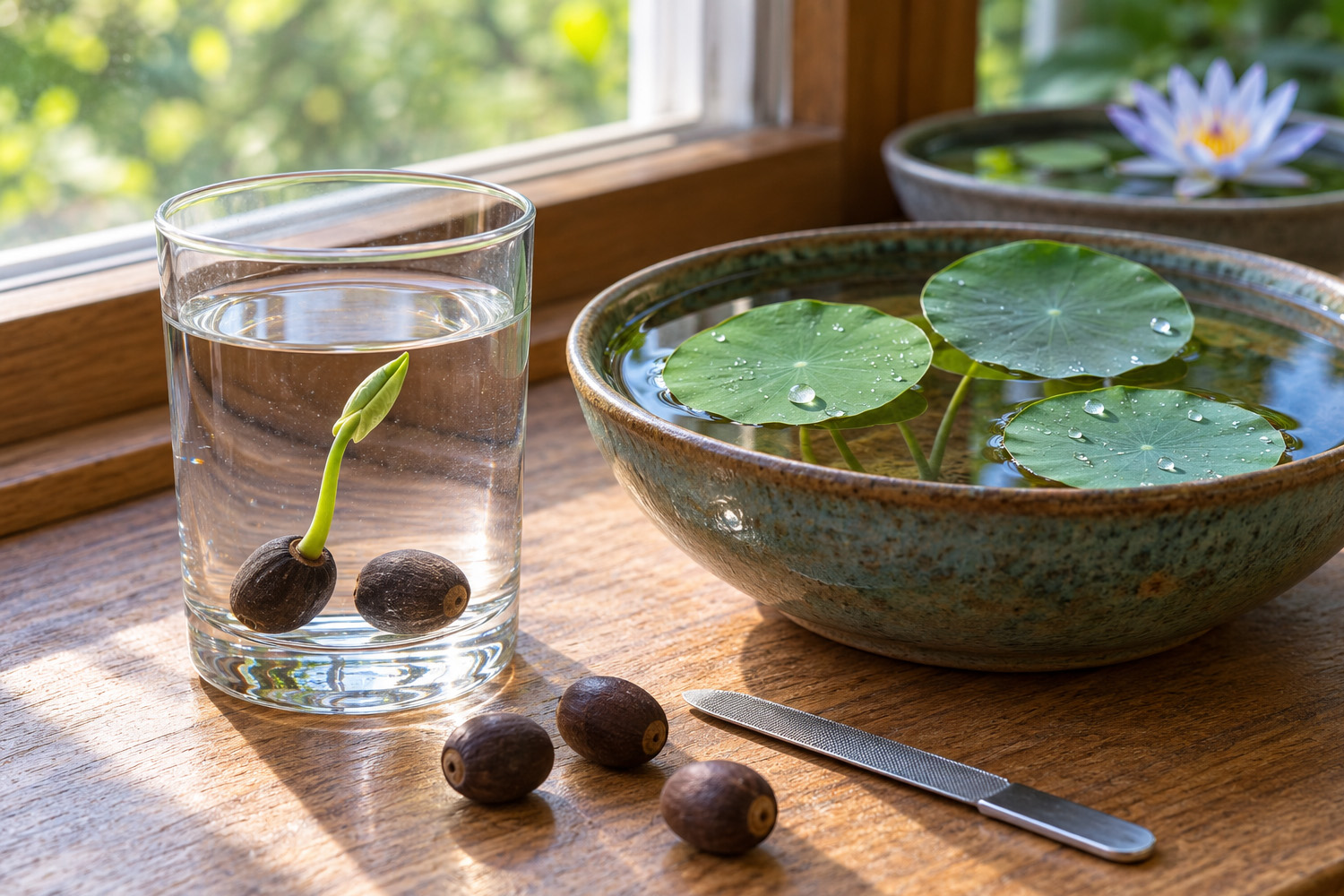
"Lotus" sounds like one plant, but when you grow it from seed you're dealing with two very different species. Sacred lotus (Nelumbo nucifera) has a rock-hard seed you need to file open first. Blue lotus (Nymphaea caerulea) is actually a water lily, with tiny seeds you leave untouched. Below you'll find, for each species, how to germinate the seeds, how to pot up the seedling and how to get the plant through a cold winter.
Sacred lotus vs blue lotus
Sacred lotus grows from a rhizome in the mud. Its round, water-repellent leaves and pink flowers rise high above the water on long stalks. Blue lotus belongs to the water lilies: its leaves float flat on the surface and its pale blue, star-shaped flowers open in the morning and close by early afternoon. Both come from warm regions, and neither survives frost in a container.
| Sacred lotus | Blue lotus | |
|---|---|---|
| Botanical name | Nelumbo nucifera | Nymphaea caerulea |
| Family | Lotus family (Nelumbonaceae) | Water lily family (Nymphaeaceae) |
| Origin | India to East Asia and Australia | Nile valley and East Africa |
| Leaves | Held above the water on long stalks | Floating on the surface |
| Seed | Large and very hard, scarify first | Tiny, no scarifying |
| Germination temperature | 25 to 29 °C (77 to 84 °F) | 25 to 30 °C (77 to 86 °F) |
| Water depth, mature plant | 5 to 20 cm (2 to 8 in) above the soil | 20 to 40 cm (8 to 16 in) above the soil |
Growing sacred lotus from seed
Sacred lotus seed is famous for its longevity: seeds more than a thousand years old have been germinated from archaeological finds. That hard brown seed coat barely lets any water in, so without help the seed simply sits there.
Step 1: scarify the seed
Hold the seed firmly and file or sand the round, convex end until you see the pale inner layer. Don't file further than you need to, and never in the middle of the seed. That's where the embryo sits, and once it's damaged, nothing will grow.
Step 2: germinate in water
- Put the filed seeds in a glass or container of clean water at 25 to 29 °C (77 to 84 °F).
- Keep it somewhere bright and warm, for example on a windowsill above a radiator.
- Change the water every day. Cloudy water means bacteria, and the seed will rot.
- The seed usually swells within a day or two. After a few days to just over a week, a green shoot appears.
Step 3: pot up the seedling
Once there are two or three small leaves and the first roots show, the seedling is ready for soil. Use a wide container without drainage holes, filled with heavy clay or garden loam. Regular potting mix is too light and floats.
- Gently press the seed a few centimetres into the soil, leaving the shoot free.
- Fill the container with water to about 5 cm (2 in) above the soil.
- Give it the sunniest spot you have, ideally six to eight hours of sun a day.
- Raise the water level as the plant grows, up to around 15 to 20 cm (6 to 8 in).
Repot a lotus as little as possible. The rhizome is fragile and the plant sulks after damage, so pick a container it can stay in for a full season. Seed-grown lotus usually flowers in its second season.
Growing blue lotus from seed
Blue lotus seeds are about the size of poppy seeds. Scarifying isn't needed, and frankly isn't possible. What they do need is warm water and plenty of light.
- Fill a small pot with heavy garden soil or clay and scatter the seeds thinly over the surface.
- Sprinkle a thin layer of sand on top so the seeds don't float away.
- Stand the pot in a tub or aquarium so there's 2 to 5 cm (1 to 2 in) of water above the soil.
- Keep the water at 25 to 30 °C (77 to 86 °F). An aquarium heater makes this much easier.
- Place everything somewhere very bright or under a grow light. Germination usually takes one to several weeks.
The first leaves are narrow and stay underwater. Round leaves follow and grow towards the surface. Raise the water level step by step so the leaves just reach the top. A mature plant prefers 20 to 40 cm (8 to 16 in) of water, full sun and calm water with no current. Blue lotus is a heavy feeder, so push an aquatic plant fertiliser tablet into the soil every few weeks.
Overwintering in a cool climate
Neither species is winter-hardy in a container in Northern Europe or the colder parts of the US. In autumn the leaves die back and the plant retreats into its rhizome or tuber.
- Sacred lotus: move the container somewhere frost-free, such as a cool cellar or garage at 5 to 10 °C (41 to 50 °F). Keep the soil wet. In spring, once the water is back above 20 °C (68 °F), it sprouts again.
- Blue lotus: keep it indoors in a warm aquarium, or lift the tuber and store it in damp sand somewhere cool and frost-free until spring.
Common mistakes
- Not scarifying sacred lotus seed: without an opening the seed can't absorb water and will never germinate.
- Not changing the water: cloudy water rots seeds and young shoots.
- Using potting mix: it's too light, floats up and clouds the water. Use clay or heavy garden soil.
- Moving outside too early: below 20 °C (68 °F) water temperature, growth stops. Wait until late spring or early summer.
- Too little sun: both species only flower with lots of direct light.
Is it legal to grow lotus?
In the Netherlands and most of Europe and the US, you can grow both species freely. Blue lotus is regulated in a few places, such as Russia since 2009, and in Louisiana it may not be sold for human consumption. Always check your local rules. And never release a lotus into a natural pond or waterway, as non-native water plants can crowd out native species.
Safety
Both plants contain aporphine alkaloids such as nuciferine. The seeds in our shop are meant for growing, not for eating or drinking. Store them dry and out of reach of children and pets. Avalon doesn't give usage advice, and all our products are for adults aged 18 and over only.
Frequently asked questions
How long do lotus seeds take to germinate?
Scarified sacred lotus seed usually swells within a day or two and shows a shoot after a few days to just over a week. Blue lotus takes longer, usually one to several weeks.
Will lotus from seed flower in its first year?
Sacred lotus usually won't: in its first summer it mostly builds up its rhizome. With plenty of sun, warmth and feeding, it often flowers in the second season.
Can I grow lotus indoors?
Germinating and the first few weeks work fine indoors. After that, sacred lotus especially wants lots of sun. A sunny patio or balcony in summer works best.
Do I need to scarify blue lotus seeds too?
No. The seeds are far too small and germinate untreated, as long as the water is warm enough.
Where can I buy lotus seeds?
You'll find sacred lotus seeds (Nelumbo nucifera) and blue lotus seeds (Nymphaea caerulea) in our exotic seeds category. Looking for another grow-from-seed project? Read how to grow Hawaiian baby woodrose from seed.


