

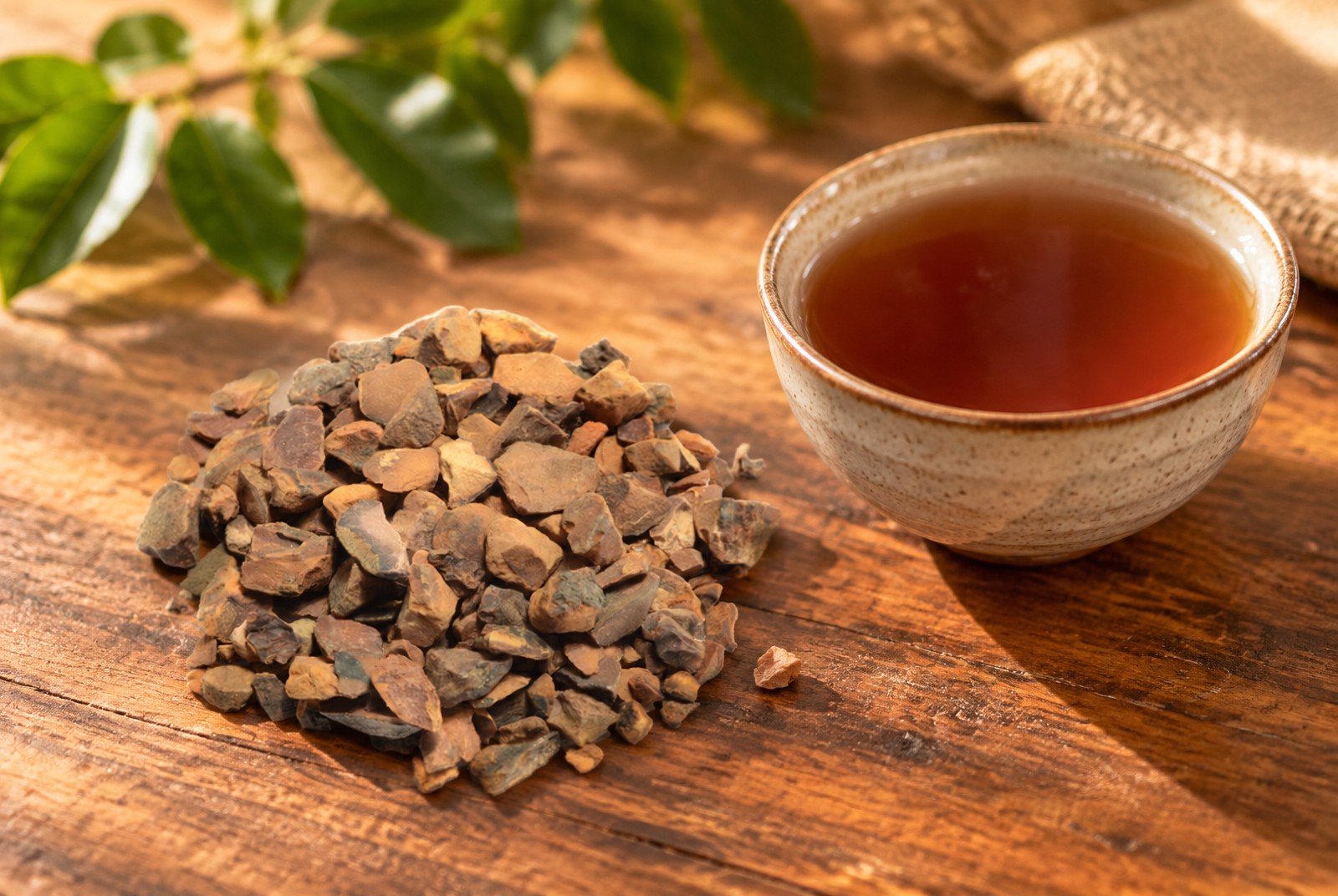
Most people only know the kola nut from the name Coca-Cola, and that is a shame. Gram for gram, this West African seed packs roughly 2 to 3.5 percent caffeine, more than double what an arabica coffee bean contains. But caffeine is only half the story.
Theobromine makes it different
Alongside caffeine, kola nut contains 1 to 2 percent theobromine, the same compound that gives cacao its gentle lift. Theobromine widens blood vessels instead of narrowing them, and its effect builds slowly and lasts longer than caffeine. The combination produces an energy that feels steadier than coffee, without that jittery edge after cup number three.
We at Avalon notice that customers who already know guarana or yerba mate reach for kola nut the quickest. Makes sense, they are all energy herbs. Does guarana also contain theobromine? No. Guarana is mainly a caffeine source, and a potent one at that. Kola nut is the only herb in our shop that combines both compounds in real quantities.
How to use kola nut
The traditional way is to break off a piece and chew it slowly. The first taste is firmly bitter, a bit earthy. The longer you chew, the more a subtle aromatic note comes through. Not everyone loves it right away, honestly.
If chewing is not your thing, grate or pound the nut and steep it in hot water for 15 to 20 minutes. The water turns a reddish brown. Add a bit of honey and a slice of ginger, and you have a drink that is surprisingly good and keeps you calmly awake for about three hours. Some customers grind the nut and stir it into coffee or hot chocolate, but we think that wastes the bitterness. And yes, we mean that as a compliment to the nut!
The Coca-Cola story
In 1886, pharmacist John Pemberton in Atlanta made a syrup using two ingredients he found interesting, coca leaf extract and kola nut extract. His bookkeeper Frank Robinson came up with the name Coca-Cola. You know the rest.
What fewer people know, modern cola drinks have not contained real kola nut for decades. The cola flavour comes from synthetic aromas and the caffeine is synthetic too. The nut outlived the brand, but the brand forgot the nut. We find something almost poetic about that, because the original ingredient is still out there and costs less than a bottle of cola.
More than a herb
The kola tree (Cola nitida and Cola acuminata) grows in the humid forsts of West Africa, where the nut has played a role far beyond nutrition for centuries. Among the Igbo in Nigeria, the kola nut is presented first at every gathering, from births to funerals, from trade agreements to sealing peace after a conflict. Among the Yoruba, four pieces of kola nut are cast as a form of divination, similar to how other cultures use dice or coins. In markets, the nut even served as currency, and labourers chewed a piece during the working day to fight hunger and fatigue.
That centuries-old tradition is exactly why we do not just file kola nut as another "energizer". There is a real human story behind that bitter little nut.
Our bag of Colanut 50 gram contains dried pieces of kola nut. A few grams is roughly equivalent in caffeine to a strong cup of coffee, so start gently if you have not tried it before. Store the bag closed, cool and dark. If you take medication or are pregnant, consult your doctor or pharmacist first.
Curious about more energy herbs? Read our blog on energizers too.