

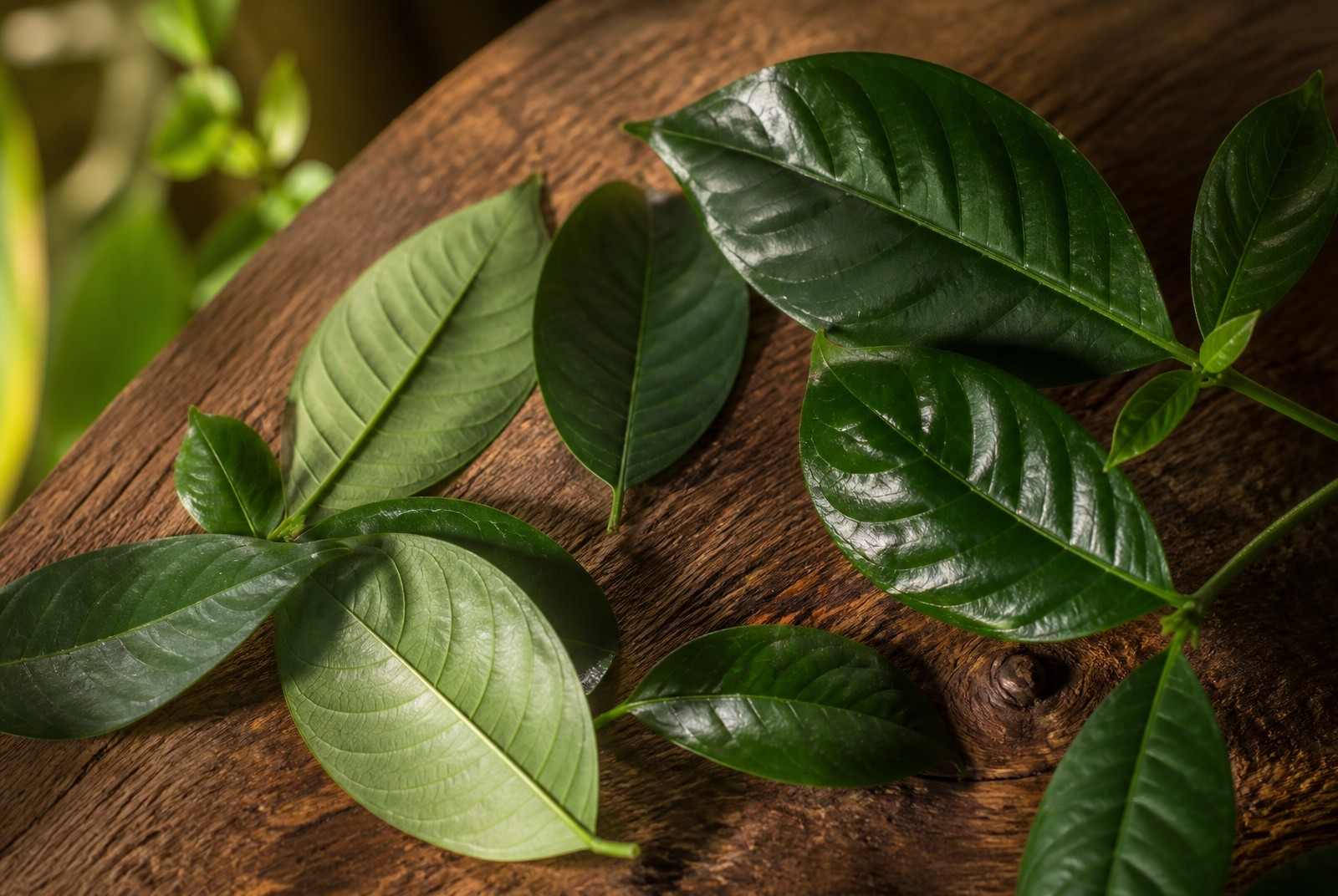
In 1779, the German botanist Christiaan Hendrik Persoon first described a plant from the coffee family (Rubiaceae) that indigenous peoples in the Amazon Basin had called chacruna for centuries. That plant, Psychotria viridis, remained a footnote in Western herbaria for a long time. It was not until the 1960s and 1970s, when researchers such as Richard Evans Schultes and Dennis McKenna systematically documented the ethnobotany of the Amazon region, that the central role of chacruna in the traditional plant medicine of peoples like the Shipibo-Conibo and the Ashuar became clear.
At Avalon Magic Plants, we sell dried Psychotria viridis leaves as a botanical specimen. This article is about the plant itself: where does it come from, how do you identify it, how can you grow chacruna indoors, and how does it differ from other DMT-containing plants?
Origin and natural habitat
Psychotria viridis grows wild in the tropical rainforests of the western Amazon Basin, from the lowlands of Peru and Ecuador to northern Brazil and Colombia. The plant prefers the shaded understorey of the rainforest, sheltered beneath the canopy of taller trees. In this environment, humidity remains consistently above 80% and temperatures fluctuate between 22 and 30 degrees Celsius.
The Quechua name chacruna derives from the word chaqruy, meaning "to mix." This refers to the traditional combination of the leaves with the stems of Banisteriopsis caapi. While B. caapi provides the MAO-inhibiting harmala alkaloids, Psychotria viridis contains the tryptamine N,N-DMT. The synergy between these two plants is one of the most remarkable examples of ethnopharmacological knowledge in human history.
Botanical characteristics: how to identify Psychotria viridis
Psychotria viridis is an evergreen shrub that can reach up to 5 metres in its natural habitat. In pots, it typically stays more compact, between 1 and 2 metres.
Leaves. Oblong-elliptic, 5 to 15 centimetres long, with a glossy dark green upper surface and a lighter underside. The leaf margin is entire (not toothed). A distinguishing detail: on the underside of the leaf, in the axils of the veins, there are small pouches (domatia) that harbour mites. This is a reliable identification feature.
Flowers. Small, white to cream-coloured flowers in terminal clusters. They usually appear in spring or early summer. The flowers are bisexual and pollinated by insects.
Fruits. Small, round berries that turn red when ripe. Each berry contains two seeds. The fruits serve as food for tropical birds, which in turn disperse the seeds.
Alkaloids: what makes chacruna special?
The leaves of Psychotria viridis contain N,N-dimethyltryptamine (DMT) in concentrations between 0.1% and 0.61% of dry weight, depending on growing conditions, season and harvest timing. Besides DMT, traces of N-methyltryptamine (NMT) and beta-carbolines have been detected, though the amounts of the latter are negligible compared to the beta-carbolines in B. caapi.
A 2015 study published in Acta Poloniae Pharmaceutica confirmed that DMT concentration in chacruna leaves varies significantly by origin and season. Leaves harvested during the rainy season generally contain more alkaloids than dry-season harvests. For collectors and researchers, it is worth knowing that the phytochemical composition is not stable: what you measure depends on when and where the leaves were harvested.
Chacruna versus other DMT-containing plants
Psychotria viridis is not the only plant that contains DMT. Two other species frequently encountered in ethnobotanical literature are Mimosa hostilis (jurema preta) and Diplopterys cabrerana (chaliponga). The differences matter for anyone collecting or studying these plants.
Mimosa hostilis contains DMT primarily in its root bark, not in its leaves. The concentration in root bark is around 1 to 1.7%, considerably higher than in chacruna leaves. The plant originates from northeastern Brazil and has an entirely different tradition: it is used in the jurema ceremonies of the Kariri-Shoco and Atikum peoples.
Diplopterys cabrerana (chaliponga), like chacruna, is an Amazonian plant that carries DMT in its leaves, but with a broader alkaloid profile: besides DMT, it also contains 5-MeO-DMT and bufotenine. In the Ecuadorian tradition, chaliponga is sometimes used as an alternative to or supplement for chacruna in ayahuasca preparations.
The most important practical difference: chacruna is the best-documented and most traditionally used DMT source in ayahuasca. Mimosa hostilis comes from an entirely different cultural and geographical context.
Growing Psychotria viridis: from leaf cutting to mature plant
Chacruna is surprisingly well-suited to growing as a houseplant, provided you respect a few basic rules. The plant is patient with beginners but punishes dry air.
Propagation. What makes P. viridis special is that it can be propagated from a single leaf. Cut a leaf with a small piece of stem (2-3 cm) from the mother plant, dip the cut end in rooting powder and plant it in moist, well-draining substrate. Keep the soil moist but not waterlogged and cover with a clear plastic bag or dome to maintain high humidity. After 4 to 8 weeks, the first roots appear.
Seed propagation is trickier. Chacruna seeds lose their viability quickly: only use fresh, still-moist seeds. Germination takes 4 to 12 weeks at temperatures between 24 and 29 degrees Celsius. The sowing medium must be sterile and slightly acidic (pH 5.5-6.5). A mix of peat, perlite and a small amount of sand works well.
Light. Partial shade, just like in the rainforest. Direct afternoon sun scorches the leaves and gives them a yellow-green discolouration. A spot near an east or north-facing window, or under 30-50% shade cloth, is ideal.
Water and humidity. Never let the soil dry out completely. Chacruna comes from an environment where it rains almost daily. Mist the leaves regularly or place the pot on a tray of wet pebbles. Humidity of 60% or higher is desirable; below 40%, the plant starts losing leaf tips.
Soil. Well-draining, slightly acidic (pH 5.5-6.5). A mix of sphagnum moss, perlite and a bit of orchid bark works excellently. Avoid calcareous potting soil.
Pests. The most common threats are mealybugs, spider mites and scale insects. Check the undersides of the leaves regularly. A treatment with neem oil or a mild soap solution works preventively.
Legal context in the Netherlands and Europe
The legal situation surrounding Psychotria viridis in the Netherlands is nuanced. The plant itself and its leaves are not listed on Schedule I or II of the Opium Act. DMT as a pure substance is a Schedule I substance. In practice, this means that possessing dried chacruna leaves for botanical purposes is not a criminal offence, while extracting or preparing DMT-containing preparations can be.
Within Europe, the situation varies by country. In Spain, the High Court of Justice of Madrid ruled in 2025 that ayahuasca as a plant preparation is not explicitly listed as a controlled substance and that possession without intent to distribute is not automatically criminal. In France and Germany, the legislation is stricter. Always consult the local laws of your own country before purchasing this plant.
At Avalon Magic Plants, we sell chacruna leaves exclusively as a botanical specimen for collectors and educational use, not for consumption.
Frequently asked questions
How much light does Psychotria viridis need?
Partial shade. The plant grows best with indirect light or morning sun. Avoid bright afternoon sun, which causes the leaves to bleach.
Can I grow chacruna outdoors in Western Europe?
Only during the summer months in a sheltered, shaded spot. The plant cannot tolerate temperatures below 10 degrees Celsius and must be brought indoors in autumn.
What is the difference between chacruna and chaliponga?
Both are Amazonian plants that carry DMT in their leaves, but chaliponga (Diplopterys cabrerana) also contains 5-MeO-DMT and bufotenine. Chacruna has a longer documentation history in the ayahuasca tradition.
How fast does a chacruna cutting grow?
Expect 4 to 8 weeks for initial root formation and 6 to 12 months for a plant of 30 centimetres. Chacruna grows slowly; patience is the most important growing tip.
Are Psychotria viridis leaves legal in the Netherlands?
Yes, dried chacruna leaves as a botanical specimen are legal to possess. DMT as an extracted substance falls under Schedule I of the Opium Act. For more background, read our blog about ayahuasca and what you need to know.