

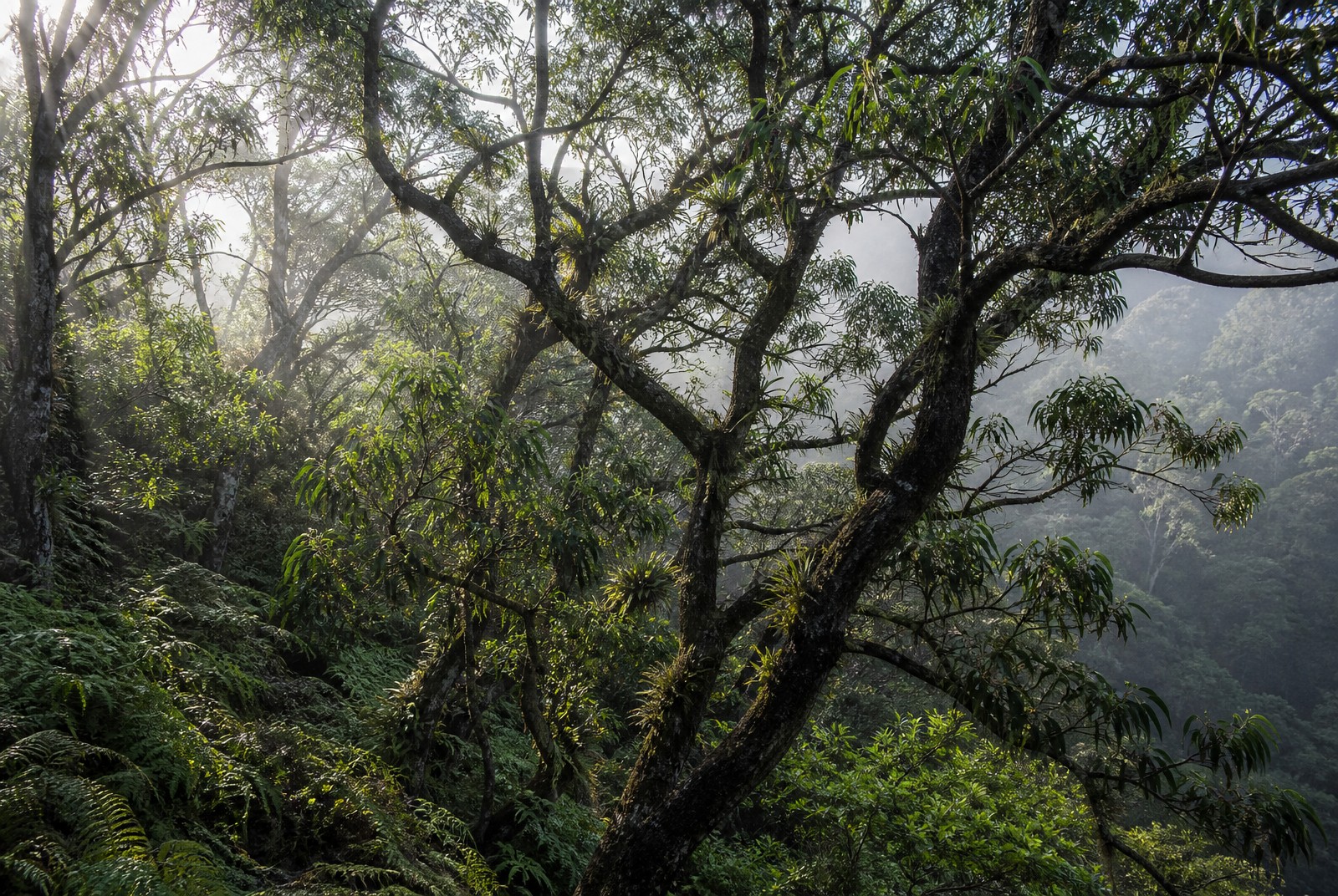
In 1912, Japanese botanist Bunzo Hayata described an evergreen tree growing on the slopes of Taiwan's Central Mountain Range between 300 and 800 metres elevation. He named it Acacia confusa, a reference to the confusion the plant had caused in earlier classification attempts: its phyllodes (flattened leaf stalks that function as leaves) resembled those of related species, but the inflorescences and pods diverged. More than a century later, that same tree is one of the most sought-after specimens in the ethnobotanical collecting world.
Origin and distribution
Acacia confusa is native to Taiwan, the Philippines and parts of southern China (Fujian, Guangdong). The tree thrives on poor, slightly acidic soils in subtropical climates where temperatures rarely drop below 10 degrees Celsius. On Taiwan, the species occurs from sea level to approximately 1,500 metres, but the highest densities are found between 300 and 800 metres on the western slopes of the Zhongyang mountain range.
Outside Asia, Acacia confusa has naturalised on Hawaii, where it was planted as an erosion control measure in the 1940s. The trees did so well that they are now considered locally invasive. Populations of tens of thousands of specimens stand on the Big Island of Hawaii, some older than 80 years.
Identification: what does the tree look like?
Acacia confusa is an evergreen tree reaching 10 to 15 metres in height, with a single trunk and a broad, irregular crown. A striking feature: the tree does not carry true leaves. Instead, it has phyllodes, flattened petioles 8 to 10 centimetres long that take over photosynthesis. Young seedlings do produce briefly compound leaflets, but these disappear within the first year of growth.
Flowers appear between April and October as round, golden-yellow globes of roughly 6 millimetres in diameter, bundled in clusters of five to ten. After flowering, flat brown pods of 5 to 8 centimetres form, each containing three to five seeds. The bark of mature trees is dark brown to grey-brown with deep, longitudinal fissures.
Traditional use in Asia
In traditional Chinese medicine, Acacia confusa is documented as a remedy for blood stasis and wound healing. Taiwanese field research from the 1990s recorded that Paiwan and Rukai communities in southern Taiwan used the inner bark as a wound dressing for cuts and abrasions. The high tannin concentration in the bark, between 23 and 35 per cent of dry weight, has an astringent effect on tissue.
Those same tannins have made the bark useful as a natural dye for centuries. In Taiwan and southern China, Acacia confusa bark was used to tan leather and colour textiles dark brown to reddish-brown. In some regions, that tradition never disappeared: local artisans continue to work with it.
What does the root bark contain?
Scientific interest in Acacia confusa centres on the alkaloid profile of its root bark. Analyses show a total alkaloid content of 0.1 to 1.4 per cent of dry weight, depending on genetics, soil composition, season, tree age and post-harvest processing. The outer periderm (cork and cork-bark layer) contains the highest concentrations; the inner xylem contributes minimally.
Trees older than 60 years generally produce bark with higher alkaloid content than younger specimens. This explains why Acacia confusa root bark at Avalon Magic Plants comes from trees aged between 60 and 100 years: the age of the tree is a determining factor for the specimen's composition.
Besides alkaloids, the bark contains flavonoids (melanoxetin, okanin), terpenoids and the previously mentioned tannins. That combination makes the bark interesting to researchers across disciplines, from pharmacognosy to materials science.
Acacia confusa versus Mimosa hostilis
Collectors often ask: how does it differ from Mimosa hostilis? Both plants are botanical specimens with a tryptamine alkaloid profile, but the similarities end there.
Mimosa hostilis (Jurema Preta) is a shrub to small tree from Brazil's caatinga, the dry scrubland of the northeast. Acacia confusa is a substantial tree from subtropical rainforest. Mimosa hostilis is typically harvested from younger plants (5 to 15 years), while Acacia confusa bark comes from trees decades old. The alkaloid profile also differs: Mimosa hostilis contains primarily N,N-DMT, whereas Acacia confusa analyses also reveal trace amounts of NMT and occasionally 5-MeO-DMT.
Both plants have an ethnobotanical history rooted in different continents and different traditions. For more on Mimosa hostilis, read our in-depth article on Jurema Preta.
Legal status in the Netherlands and Europe
In the Netherlands, possession and sale of Acacia confusa as plant material is legal. The tree and bark are not listed under the Opium Act. However, extracting DMT from the bark is prohibited: DMT is on List I of the Dutch Opium Act. Possessing the plant itself, as a botanical specimen or for research, is not an offence.
The situation varies across EU member states. In France, DMT is listed as a narcotic substance, but the plant itself is not specifically prohibited. Germany has a comparable framework through the Betaubungsmittelgesetz. Always verify the legislation in your own country before placing an order.
Recognising quality and proper storage
Good Acacia confusa root bark has several identifying features. The pieces are firm and dry, without mould or damp patches. The inside of the bark shows a characteristic pattern of reddish-brown and orange layers, sometimes called "rainbow bark" because of the colour variations. Specimens from old trees have thicker bark (4 to 8 millimetres) than those from younger trees.
Store the bark in a cool, dry and dark place, preferably in an airtight container. Moisture is the main enemy: it can cause mould growth and alter the chemical composition. Properly stored bark retains its properties for years.
Acacia confusa among the ayahuasca plant family
In the ethnobotanical collecting world, Acacia confusa occupies a distinctive position alongside plants like Psychotria viridis (chacruna) and Banisteriopsis caapi. Where chacruna and caapi are inseparably linked to the Amazonian traditions around ayahuasca, Acacia confusa has its own East Asian ethnobotanical context. Taiwanese research from 2008 was the first to systematically document traditional use by indigenous groups on the island.
Our article on Psychotria viridis and the piece on growing Banisteriopsis caapi cover the Amazonian side of this spectrum. Acacia confusa adds an Asian chapter.
Frequently asked questions
Is Acacia confusa root bark legal in the Netherlands?
Yes. The plant and bark are legally available as a botanical specimen. Extracting DMT from the bark is prohibited under the Opium Act.
What is the difference between root bark and stem bark?
Root bark contains a higher alkaloid content than stem bark. Scientific analyses therefore almost always use root bark. Stem bark is richer in tannins and is traditionally used more often for dye purposes.
How old are the trees from which the bark is harvested?
The root bark at Avalon Magic Plants comes from trees between 60 and 100 years old in Hawaii and Taiwan. Older trees produce thicker bark with a richer phytochemical profile.
Can I grow Acacia confusa myself?
In principle, yes, but the tree requires a subtropical climate and grows slowly. In Western Europe, indoor cultivation in a greenhouse is possible; outdoor cultivation only works in Mediterranean climate zones. Expect decades of growth before the tree produces mature root bark.